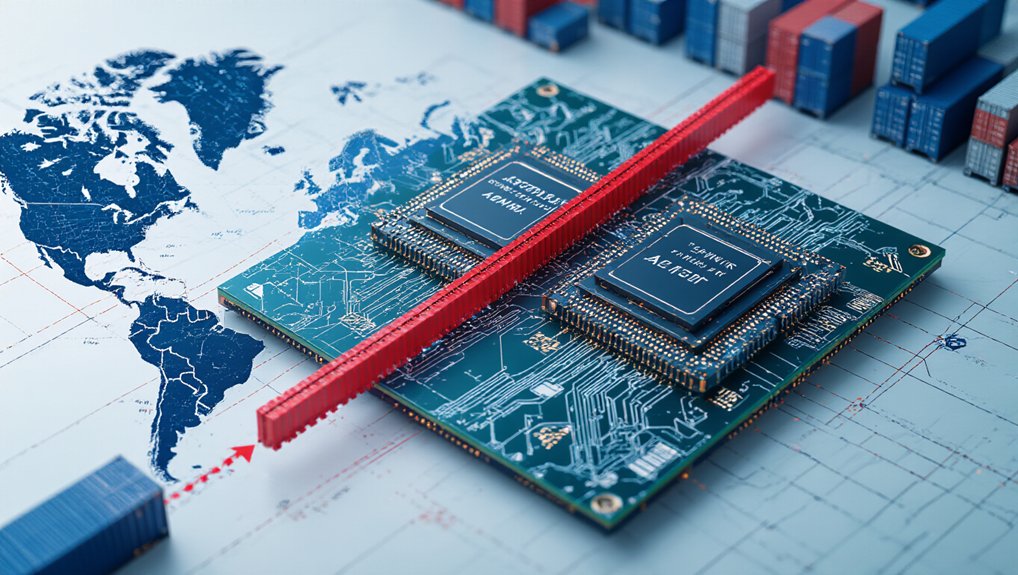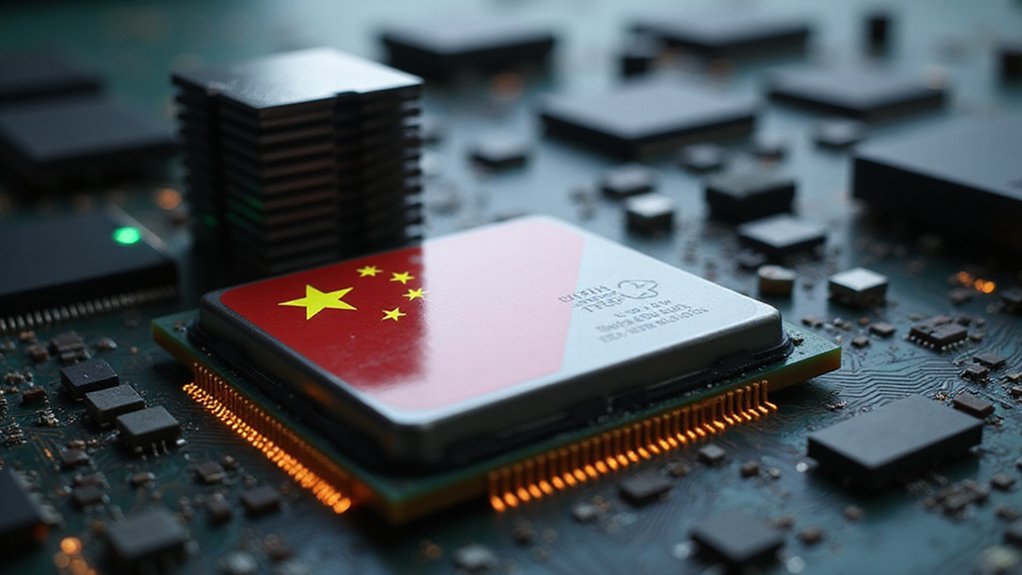

NVIDIA has carefully engineered its new H20 chip to balance performance with export compliance, deliberately reducing its power compared to the company’s flagship models. The chip delivers up to 900 TFLOPS in FP16 calculations, which is lower than H100’s 1,000 TFLOPS and H200’s 1,200 TFLOPS. This strategic downgrade keeps the H20 under U.S. export control thresholds while still offering Chinese customers significant AI processing power.
NVIDIA’s H20 chip walks a technical tightrope, deliberately underpowered to navigate export rules while still delivering impressive AI capabilities to Chinese buyers.
The technical adjustments allow NVIDIA to meet the U.S. Bureau of Industry and Security requirements for exporting to China. The H20 fulfills ECCN 3A991 conditions, making it legal to sell in Chinese markets where more powerful chips like the H100 and A100 are banned.
Despite the performance cuts, the H20 remains highly attractive to Chinese firms. It outperforms local alternatives like Huawei’s Ascend 910C, which achieves only about 60% of H100’s capabilities. This performance gap explains why Chinese orders for the H20 are estimated at $16-18 billion.
The chip features 14,592 CUDA cores and 96GB of HBM3 memory with 4.0TB/s bandwidth. NVIDIA prioritized energy efficiency, giving the H20 a 350W TDP—half that of the H100. This makes the chip well-suited for large data centers concerned with power consumption.
NVIDIA’s strategy reflects the company’s attempt to navigate complex geopolitical tensions. It faces pressure from both U.S. regulators and shareholders who value the enormous Chinese market. The enterprise-level solution costs between price range of $25,000 to $40,000 per unit. This balancing act has contributed to share price volatility, including a 15% drop in Q3 2024. With new shipments expected only by mid-2025, Chinese tech giants are competing intensely for the limited available supply.
For Chinese AI developers, the H20 offers a critical lifeline. It enables companies like DeepSeek to continue advancing their large language models despite U.S. restrictions. The chip is estimated to be 20-30% faster than leading Chinese alternatives for AI training tasks. Despite being marketed for inference, the H20 is actually 20% faster than H100 for inference tasks, raising serious concerns about its potential applications in Chinese supercomputers.
NVIDIA’s approach represents a compromise solution: powerful enough to satisfy Chinese demand while designed specifically to avoid triggering stricter U.S. export controls.