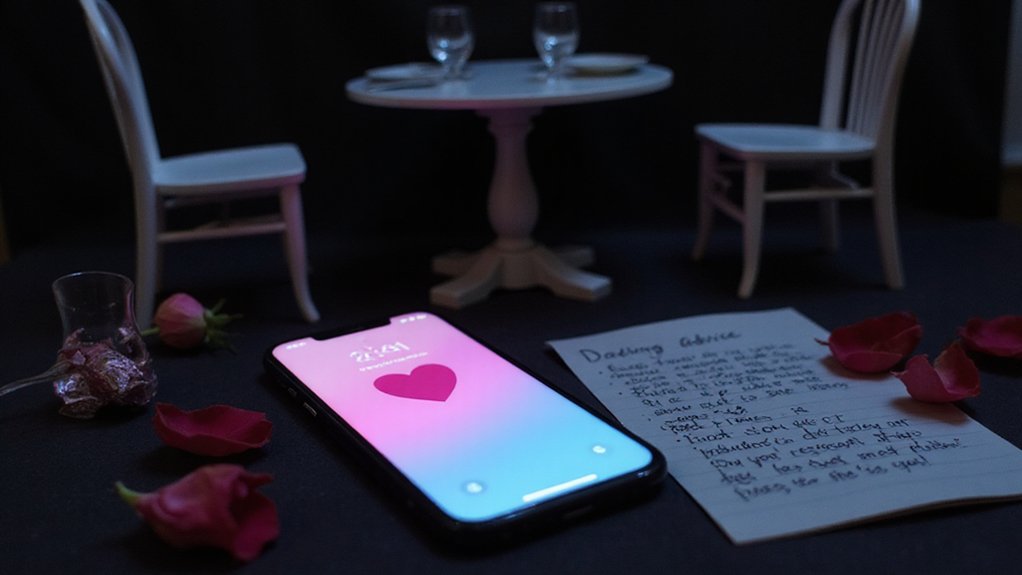

While a quarter of young adults think AI could replace real romantic relationships by 2025, the numbers tell a different story about who’s actually looking for digital love. Men search for AI girlfriends nearly four times more than women search for AI boyfriends. That’s 1.63 million monthly searches for virtual girlfriends versus, well, considerably less interest in digital dudes.
Men search for AI girlfriends four times more than women seek digital boyfriends.
The demographic breakdown is pretty stark. About 78% of people seeking AI girlfriends are male, mostly between 18 and 34. Meanwhile, 68% of AI boyfriend seekers are women, typically aged 22 to 39. So much for equal opportunity romance.
What’s driving this digital dating surge? Trust, companionship, validation. The usual suspects. People want emotional support without the judgment, practice for real relationships without the risk. Some users even report self-esteem boosts from their AI interactions. Because nothing says confidence like chatting with a computer program that’s literally programmed to like you. Users can even create digital versions of lost loved ones, extending connections beyond death itself.
The technology has evolved beyond simple chatbots. These AI companions use generative tech to create personalized experiences, adapting to user preferences and simulating emotional responsiveness. They’re not just for romance either – many serve platonic needs too. How versatile.
Here’s where it gets concerning. Experts predict up to 15% of people might consider formal, long-term commitments with AI partners by 2035. Marriage rates are already declining, and now we’re adding silicon sweethearts to the mix. Society’s normalizing these relationships rapidly, with popular media reflecting increasing acceptance.
But let’s talk risks. AI-powered romance scams are becoming sophisticated enough to fool almost anyone. In fact, 27% of users have encountered scams in AI dating environments. Emotional dependency on digital partners is a real psychological concern. Privacy issues, data misuse, manipulation risks – the list goes on.
The gender gap might narrow as more women embrace AI companions, but right now, it’s mostly dudes falling for digital girlfriends. Young men believe AI can replace human relationships at a higher rate than women – 28% versus 22%.
Whether this represents progress or a dystopian nightmare depends on your perspective. But one thing’s clear: AI romance advisors aren’t just a tech novelty anymore. They’re reshaping how we think about love, connection, and what it means to be in a relationship. Even if that relationship requires a charging cable.
References
- https://www.allaboutai.com/resources/ai-statistics/ai-dating/
- https://www.thinkadvisor.com/2025/02/26/new-advisor-survey-finds-rapid-attitude-shift-on-ai/
- https://agewisecolorado.org/blog/ai-companions-in-2025-how-her-predicted-the-future-of-love-and-technology/
- https://news.illinoisstate.edu/2025/02/love-is-in-the-air/
- https://www.amplifai.com/blog/generative-ai-statistics