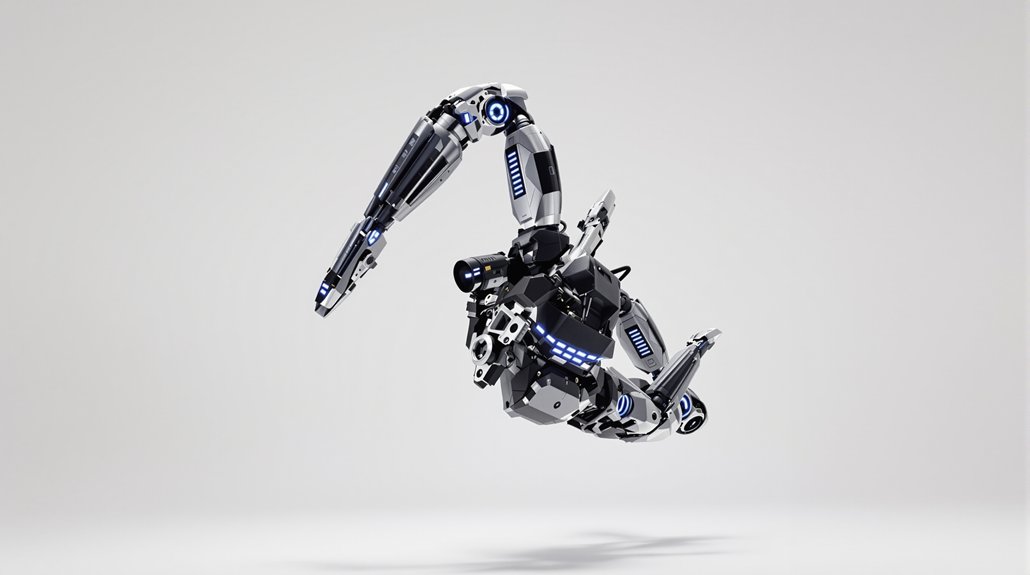

While most people struggle to do a single backflip, humanoid robots are now performing gymnast-level stunts that seem to defy gravity. These machines execute movements that challenge what engineers thought possible just years ago.
Unitree’s H1 robot recently set a Guinness World Record by sprinting at over 7.3 mph. That’s faster than many humans jog. The same robot performs standing backflips using its carbon fiber frame and powerful knee actuators that produce 600 Newton-meters of torque.
Unitree’s H1 robot sprints faster than many humans jog while performing standing backflips with 600 Newton-meters of torque.
Boston Dynamics’ Atlas robot takes stunts even further. It leaps between platforms, vaults over obstacles, and completes backflips off boxes. The company upgraded Atlas with electric actuators in 2024, replacing its old hydraulic system. This change made the robot’s movements smoother and more human-like.
These robots don’t just perform pre-programmed tricks. They adapt in real time. When engineers shove the H1 robot, it recovers instantly without falling. Atlas shows what researchers call “ninja goat” reflexes, bouncing back from pushes and disturbances. The H1’s computer recalculates its walking cycle 500 times per second, letting it adjust to changing conditions immediately.
Other robots join this athletic uprising. The R1 prototype uses its 26 degrees of flexibility to perform 360-degree spin kicks. The S1 model moves its arms at speeds up to 10 meters per second. It’s fast enough to pull a tablecloth from under wine glasses without knocking them over. Beijing’s Booster T1 demonstrates its agility by playing soccer and executing kung fu moves despite its compact 1.2-meter frame. RobotEra’s L7 humanoid achieves running speeds of 14.4 km/h, matching the pace of a moderate human sprint.
The STAR 1 robot uses modular actuators that engineers can reconfigure for different stunts. Public demonstrations showcase these abilities regularly. Atlas performs at tech expos, running obstacle courses and jumping between boxes.
Walker 02 robots train for factory work and security patrols, needing robust movement skills for these jobs. The DroidUp Xueba-01 even entered a Shanghai Theater Academy program, using its movement abilities for opera performances.
These machines achieve their athletic feats through advanced engineering. Atlas operates 28 joints in its five-foot frame. Sensors and AI help robots detect and avoid dynamic obstacles. They navigate uneven terrain during stunts.
Each breakthrough brings robots closer to matching human physical abilities, transforming what once seemed like science fiction into demonstrated reality.