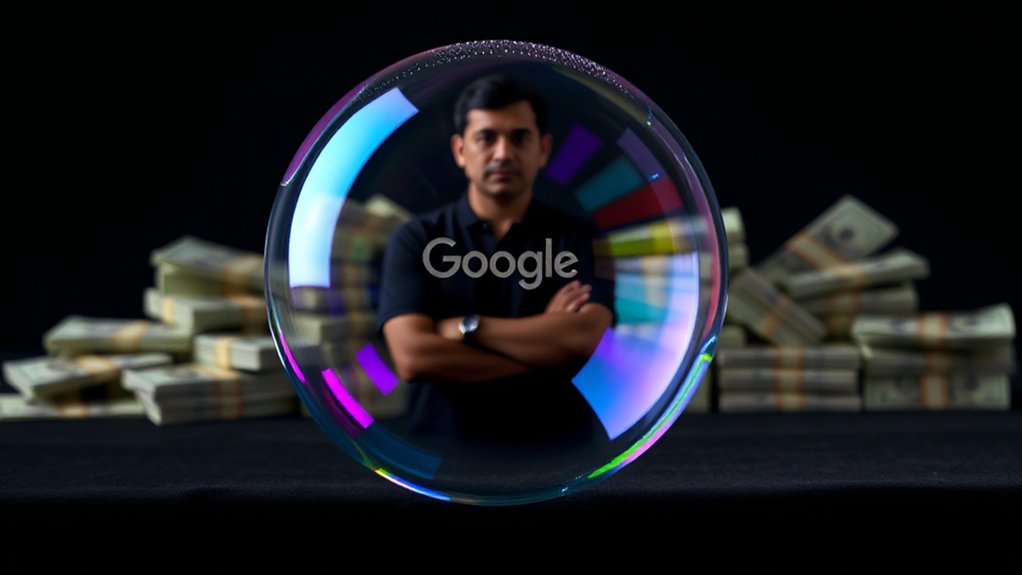

As AI investments continue to skyrocket, financial experts are sounding the alarm about a potential bubble forming in the market. Recent data shows that AI-related investments peaked around late 2024 and early 2025, with a notable surge after the launch of Chinese chatbot DeepSeek in early 2025, which caused significant market fluctuations.
The market concentration has reached concerning levels, with over 80% of gains in the American stock market in 2025 attributed to AI-related enterprises. The S&P 500 now sees about 30% of its value reliant on just five AI giants, a concentration not witnessed in 50 years.
Market concentration reaches alarming levels as AI firms dominate 80% of stock gains, with just five companies controlling nearly a third of the S&P 500.
Enterprise AI investment reached approximately $30–40 billion by mid-2025, yet a shocking 95% of organizations reported zero return on this deployment. Despite this lack of return, projected AI spending is expected to exceed $1.6 trillion between 2026 and 2029.
The valuation of leading AI companies has soared to over $5 trillion as of October 2025, exceeding the GDP of all countries except the US and China. Nvidia became the first company to reach a 4 trillion market value in July 2025 before continuing its meteoric rise. This rapid growth has led many experts to compare the current situation to the dot-com bubble of the late 1990s.
AI adoption within businesses has doubled from 3.7% in 2023 to nearly 10% by September 2025. The percentage of businesses expecting to implement AI in the next six months has also increased from 6.3% to 14.0%. However, the disconnect between adoption rates and actual value creation raises concerns about speculative excess in the market. With projections suggesting AI could add $15.7 trillion to the global economy by 2030, many investors remain bullish despite current warning signs.
Unlike the dot-com era, today’s AI investments are often funded from actual profits rather than purely speculative capital. Major tech companies have strong balance sheets supporting their AI initiatives. There’s also real user demand driving some of the growth.
Still, warning signs remain clear. The S&P 500 is priced at 23 times forward earnings, higher than during the dot-com bubble. Many prominent figures, including OpenAI’s CEO and Bridgewater Associates’ Ray Dalio, have described the market behavior as potentially “irrational,” suggesting investors should proceed with caution in this rapidly evolving landscape.