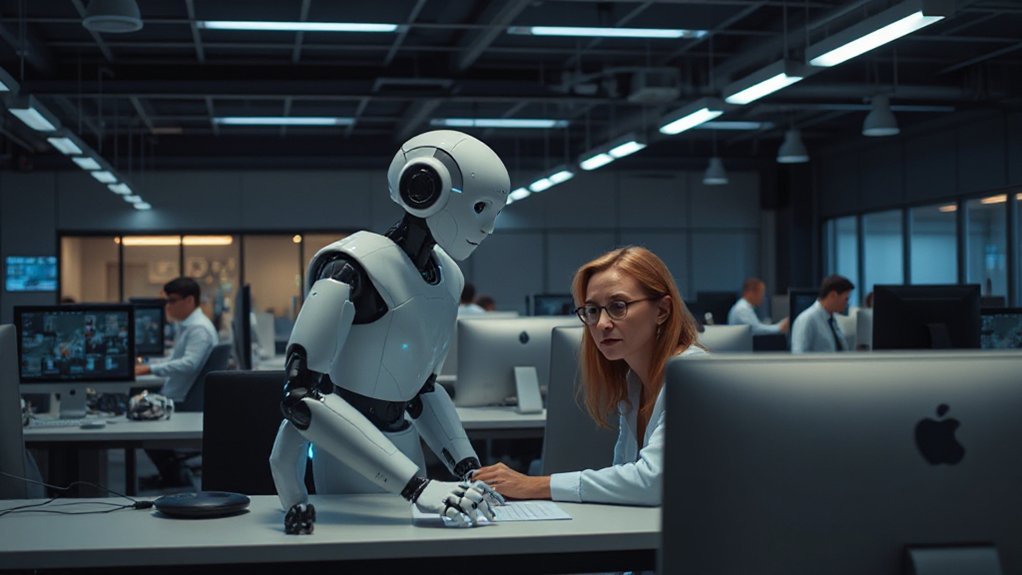

As artificial intelligence continues to advance, a recent study reveals that AI can now perform tasks currently done by nearly 12% of the American workforce. The thorough MIT research analyzed over 150 million workers across approximately 1,000 occupations using their “Iceberg Index,” which measures how much job duties overlap with AI capabilities.
The study found that AI demonstrates both cognitive and technical abilities across several major sectors. Technology, finance, health care, and professional services are particularly affected. However, researchers caution that the study doesn’t predict total job loss or current displacement rates.
Technology jobs face significant impact as AI now generates billions of lines of code daily. Software engineers aren’t losing their jobs, but their roles are shifting from basic coding to more advanced functions. Similarly, financial analysts spend less time on routine document processing as AI handles these tasks.
Healthcare workers like nurses benefit from AI by spending less time on paperwork and more time with patients. This pattern repeats across industries – AI handles repetitive tasks while humans focus on higher-value activities. Manufacturing companies increasingly implement AI for quality control and automated inspections.
Entry-level positions face particular challenges as traditional hiring pipelines change. Recent graduates and inexperienced workers may find fewer opportunities as AI automates many starter tasks. This shifts demand toward mid and high-level skills.
Multiple factors influence how quickly AI replaces human tasks. Business priorities, societal acceptance, regulations, and economic conditions all play important roles. Individual companies ultimately decide which functions to automate.
Workers increasingly need skills that complement AI rather than compete with it. Complex problem-solving and interpersonal abilities remain valuable while routine cognitive tasks face automation. Continuous learning has become essential to staying relevant.
Rather than eliminating jobs entirely, AI often reshapes how work gets done. Many occupations experience restructuring without reducing total headcount. The technology creates efficiency gains that reorganize work rather than simply replacing workers. The pharmaceutical industry demonstrates how AI dramatically cuts drug development timelines from 15 years to as little as 18 months.
References
* https://www.cbsnews.com/news/ai-artificial-intelligence-workers-mit-study/