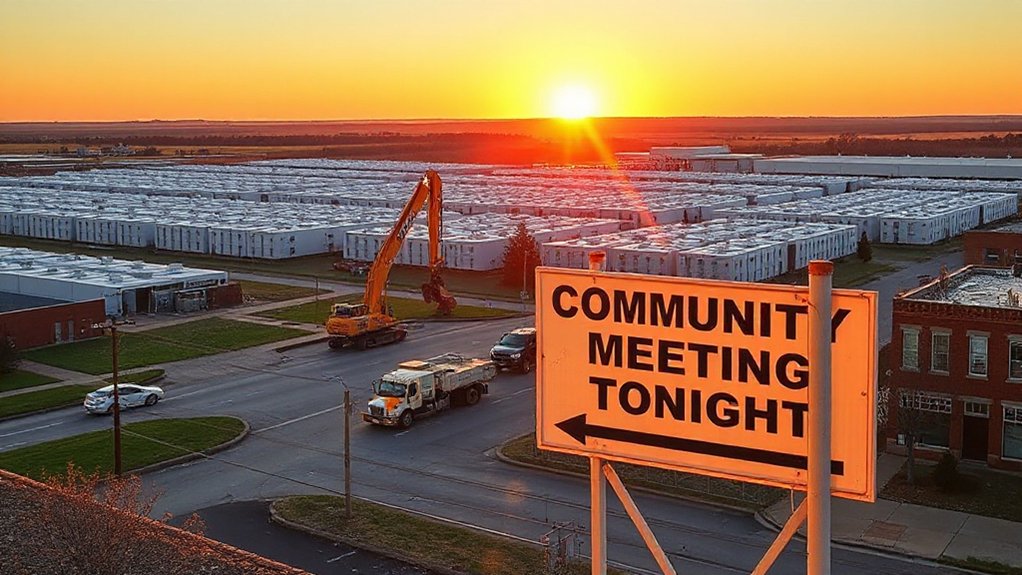

Increasingly, communities across America are welcoming data centers as major economic drivers. These massive facilities house the computers that power our internet services and are attracting huge investments. By 2030, global data center infrastructure is expected to draw $6.7 trillion in spending.
In Northern Virginia, data centers generated about $31 billion in economic output last year. But the question remains: Do these benefits reach the broader community?
The construction phase brings a temporary boom. In one Florida project, a $670 million investment created over 45,000 temporary jobs and produced $824 million in economic impact. Workers filled local hotels and restaurants, boosting many businesses for a short time.
Once built, however, the picture changes. The same Florida project resulted in just 547 permanent jobs. Data centers are highly automated facilities that need relatively few workers compared to their massive investment. They’re capital-intensive, not labor-intensive.
Data centers: massive investments, minimal staffing. These tech giants create wealth without creating many jobs.
Tax revenues can be substantial. That Florida project generated about $177 million in state and local taxes during construction and promises $67.5 million in recurring tax revenue. Nationwide, the industry contributed $1.36 billion in state and local taxes in 2023.
Despite claims of community benefits, data centers often lack transparency regarding impacts on surrounding neighborhoods, especially concerning environmental and health consequences.
Employment in the sector is growing, with U.S. data center jobs increasing from 306,000 to 501,000 between 2016 and 2023. But these jobs aren’t evenly distributed. California holds 17% of all data center jobs, while Texas has 10%. Many organizations may be overstating job creation potential, as typical data centers have job multipliers between 2 and 3, not the 250 sometimes claimed.
Women remain underrepresented in the industry, especially at newer companies. This gender gap limits who benefits from these new positions.
Some communities have seen data centers arrive while overall population and job counts actually declined. The centers didn’t stop broader economic trends.
For communities considering data center development, the reality is more complex than the billions in investment figures suggest. While they bring real economic benefits, these facilities don’t automatically transform local economies or create large numbers of permanent jobs.
References
- https://consumerenergyalliance.org/cms/wp-content/uploads/2025/12/Economic-Impact-of-Data-Centers.pdf
- https://ohiorivervalleyinstitute.org/why-data-centers-will-be-economic-development-duds/
- https://techpolicy.press/data-center-boom-risks-health-of-already-vulnerable-communities
- https://www.mckinsey.com/industries/public-sector/our-insights/the-data-center-balance-how-us-states-can-navigate-the-opportunities-and-challenges
- https://ncrc.org/data-centers-wont-stop-the-labor-market-slowdown-november-2025-race-jobs-and-economy-update/
- https://www.census.gov/library/stories/2025/01/data-centers.html
- https://stpp.fordschool.umich.edu/sites/stpp/files/2025-07/stpp-data-centers-2025.pdf
- https://www.pewresearch.org/short-reads/2025/10/24/what-we-know-about-energy-use-at-us-data-centers-amid-the-ai-boom/
- https://www.datacenterresearch.org