
A startup called Starcloud wants to put data centers in space — and NVIDIA is helping make it happen. The company raised $250 million in a funding round reported by Reuters on Aug. 21, 2026. That round valued Starcloud at $2.3 billion. Manhattan West led the deal. New investors included NVIDIA and Cisco Investments. Existing backers like Benchmark, EQT, and Soma also participated.
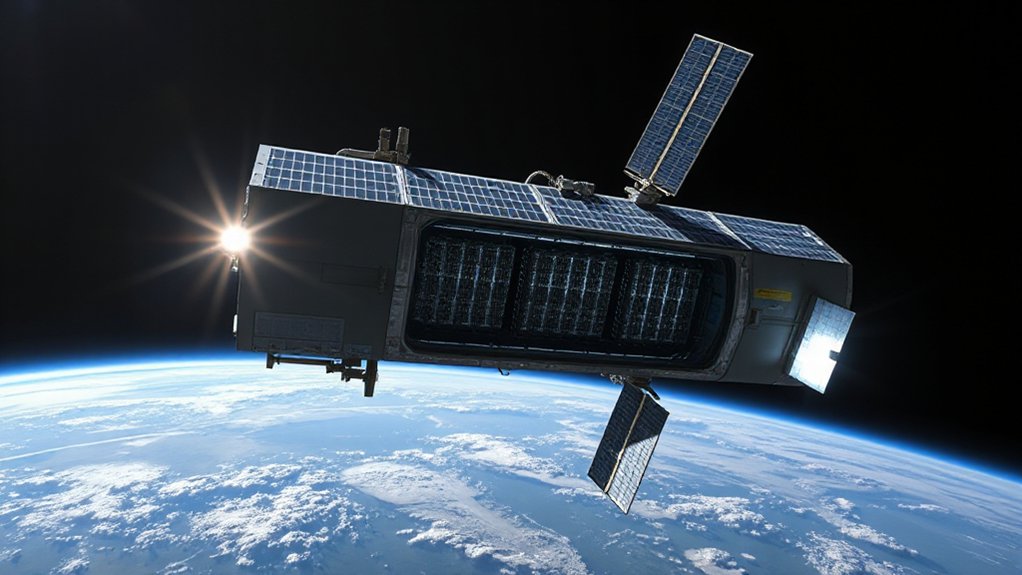
Starcloud’s big idea is to move AI computing off Earth and into orbit. Instead of building massive server farms on the ground, the company wants satellites carrying powerful computer chips to do the work in space. The goal is to process data closer to where it’s generated, cutting the need to send everything back to Earth first. It also means less dependence on terrestrial electricity, water, and ground networks.
Starcloud wants to replace Earth-bound server farms with orbital satellites that process AI workloads in space.
The company isn’t thinking small. Reuters reported that Starcloud is targeting a constellation of 88,000 satellites and 20 gigawatts of orbital compute capacity. That’s the long-term vision. Near-term plans describe a smaller 5-gigawatt orbital data center concept. Either way, these numbers point to an enormous manufacturing effort.
To support that effort, Starcloud is building a 100,000-square-foot manufacturing facility in Woodinville, Washington. The factory is meant to produce next-generation spacecraft at scale, moving beyond one-off demonstrations.
The company already has hardware in orbit. In November 2025, Starcloud launched an NVIDIA H100 GPU into space. It was described as the first data-center-class GPU deployed in orbit. Since then, the two companies have worked together on the Space-1 Vera Rubin Module, which NVIDIA says is designed for on-orbit AI and accelerated computing. The company also plans to run Google’s Gemma model on H100 GPUs in orbit, demonstrating that large language models can operate in space. During the Starcloud-1 mission, the company also successfully trained an AI model and achieved high-performance AI inference in orbit.
Starcloud points to two key advantages of space: solar power and radiative cooling. Satellites can tap sunlight for energy and radiate heat into the cold vacuum. However, NVIDIA executives have noted that cooling in space isn’t simple. Without air, there’s no convection. Heat can only escape through radiation, which is slower.
Still, the pitch is clear. Earth’s data centers need huge amounts of power and water. Starcloud argues that space offers a way around those limits — if the engineering holds up.
References
- https://blogs.nvidia.com/blog/starcloud/
- https://www.idcnova.com/news/NVIDIA-backed-startup-Starcloud-raises-250M-to-build-orbital-AI-data-centers
- https://www.reuters.com/business/media-telecom/orbital-data-center-startup-starcloud-valued-23-billion-latest-funding-2026-08-21/
- https://spaceinsider.tech/2024/10/28/lumen-orbit-advances-space-based-ai-data-centers-with-10m-funding-and-nvidia-partnership/
- https://www.cnbc.com/2025/12/10/nvidia-backed-starcloud-trains-first-ai-model-in-space-orbital-data-centers.html
- https://today.rtl.lu/news/business-and-tech/nvidia-making-ai-module-for-outer-space-626710906
- https://siliconangle.com/2026/08/21/starcloud-raises-250m-to-build-ai-data-centers-in-orbit/
- https://www.cnbc.com/2026/03/16/nvidia-chips-orbital-data-centers-space-ai.html
- https://www.nvidia.com/en-us/edge-computing/space-computing/
- https://siliconangle.com/2026/04/14/ai-satellite-constellation-startup-orbital-gets-funded-andreessen-horowitz-verify-space-based-data-center-concept/