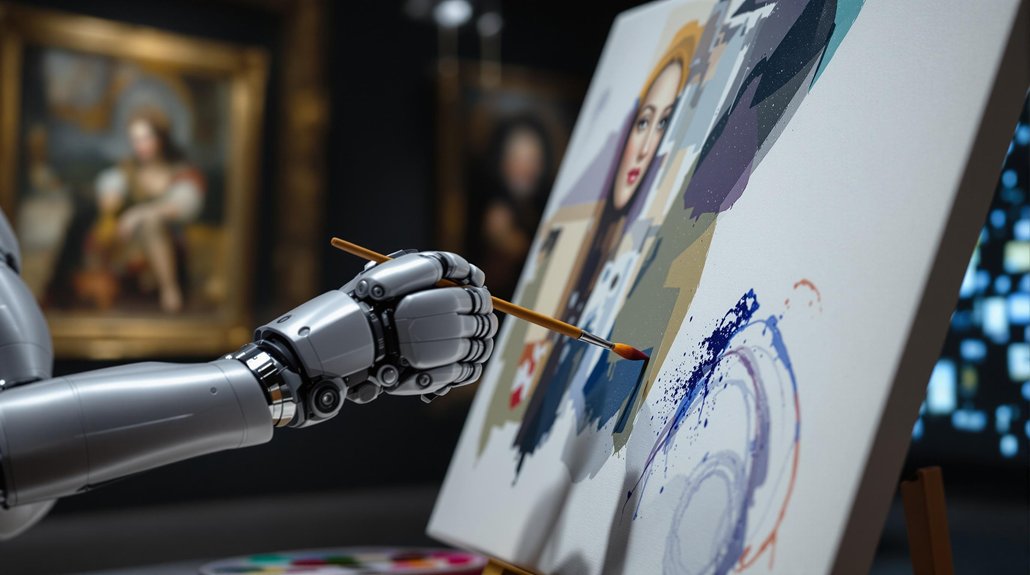
AI art tools like Midjourney and DALL-E have transformed the creative landscape. They allow anyone to create stunning images through text prompts, blending styles and producing museum-worthy pieces. Artists like Sougwen Chung now collaborate with AI, creating new artistic possibilities. Yet ethical questions persist: Who deserves credit? Is emotional depth lost? Does AI threaten traditional skills? The line between creative transformation and artistic soul-stealing remains a complex frontier to explore.
While humans once claimed art as their exclusive domain, artificial intelligence has quietly transformed the creative landscape. Today’s AI systems can analyze thousands of paintings, sculptures, and portraits to create original works that mimic human styles. These systems blend elements from different periods and push traditional aesthetic boundaries in ways never before possible.
The journey began with early computer art experiments in the 1970s. AARON, one of the first AI art programs, created abstract pieces autonomously. As technology advanced, neural networks enabled AI to learn and adapt artistic styles. Modern AI can now produce portraits that many viewers can’t distinguish from human-created art.
These AI portrait systems use generative adversarial networks (GANs) to analyze facial features, emotions, and artistic techniques. They capture subtle details like light and shadow, generating realistic and emotionally evocative images. Many can blend multiple artistic styles into one cohesive piece. Platforms like Mimic Masterpieces democratize art creation, making artistic expression accessible to individuals regardless of traditional training. Popular tools including Midjourney and DALL-E have made AI art creation possible through simple text prompts.
In sculpture, AI analyzes databases to recognize patterns and suggest innovative designs. Robots like Robotor can carve intricate designs, handling physically demanding tasks with precision. These systems translate digital models into physical forms with remarkable accuracy.
Many artists now collaborate with AI. Sougwen Chung works alongside robotic arms to create art. The “DREAM” project uses AI to transform analyzed dreams into sculptures. These partnerships merge human creativity with AI’s computational power to explore new artistic territories.
This technological shift raises important questions. Who deserves credit when AI helps create art? What happens to our understanding of creativity and originality? The balance between human and machine contributions remains unclear, as does the impact on traditional artistic skills.
The future likely holds even more sophisticated AI algorithms and new AI-compatible mediums. These developments may expand artistic expression and enhance psychological interpretation in art. However, the proliferation of AI-generated works risks creating an environment where art loses its emotional depth and nuance. As AI continues to develop, it’s reshaping our understanding of creativity itself, blurring the line between human imagination and machine generation.