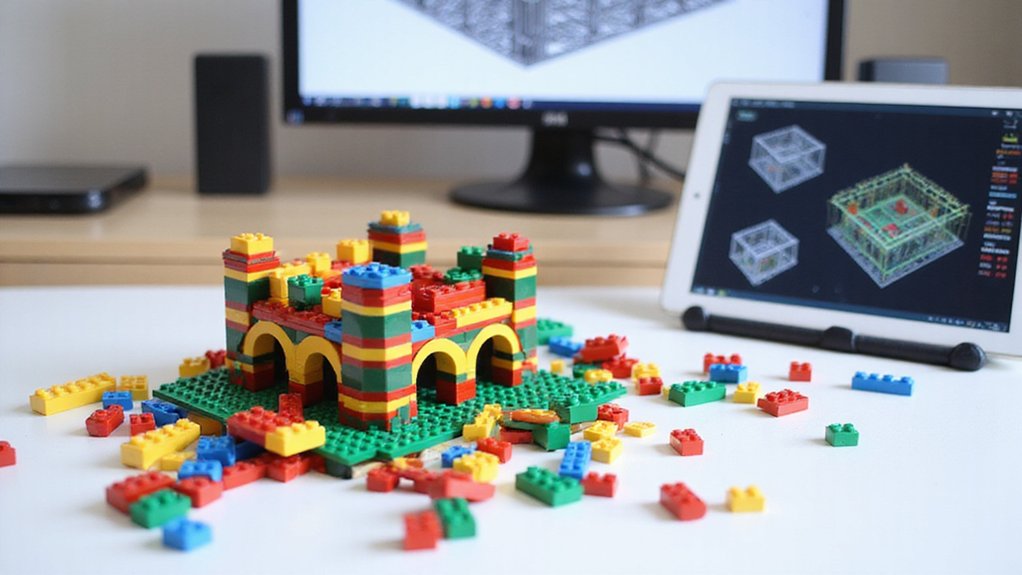

Engineers have revealed LegoGPT, an innovative artificial intelligence system that transforms simple text descriptions into buildable LEGO designs. This groundbreaking tool creates 3D LEGO structures that aren’t just visually appealing but actually stable enough to build in real life.
LegoGPT was trained on over 47,000 LEGO structures representing more than 28,000 unique 3D objects. The system maps brick layouts on a 20×20×20 grid and only keeps designs that pass strict stability tests. This guarantees the final creations won’t collapse when built.
The AI’s design process is guided by real-world physics. It knows how LEGO bricks connect and which placements won’t work in reality. During testing, LegoGPT achieved a 98% physical stability rate, meaning nearly all its designs can actually be constructed.
Creating a design with LegoGPT is simple. Users type a description of what they want, and the AI predicts each brick placement based on that text. The system can handle a wide range of requests and even adds colors and textures to make designs more visually interesting. The technology exemplifies multimodal AI integration that’s transforming how we interact with creative tools.
With just a text description, LegoGPT transforms your words into perfectly placed bricks, colors, and textures for buildable LEGO designs.
What sets LegoGPT apart is its understanding of physical laws. The AI checks each design using physics simulations to verify it’s buildable. It follows LEGO’s interlocking principles and mechanical constraints, creating instructions that work for both human builders and robots.
The tool is freely available to the public with open-source code and models on GitHub. Users can also take photos of their available LEGO bricks, and the AI will generate multiple building options based on what they already have. It’s designed for everyone from casual hobbyists to educators and researchers. Users need only basic text input skills to create complex, stable designs.
LegoGPT represents the first system to combine language, vision, and physics for LEGO design generation. The model employs physics-aware rollback during inference to ensure all creations remain buildable. This makes it a significant breakthrough in AI-driven creative tools. The innovation demonstrates how artificial intelligence can bridge digital creativity with physical construction, all starting from a simple text description.
References
- https://www.tomshardware.com/tech-industry/artificial-intelligence/legogpt-creates-stable-lego-designs-using-ai-and-text-inputs-tool-now-available-to-the-public
- https://www.arxiv.org/abs/2505.05469
- https://www.cnet.com/tech/services-and-software/you-can-now-use-legogpt-to-turn-your-text-inputs-into-lego-designs/
- https://github.com/AvaLovelace1/LegoGPT
- https://avalovelace1.github.io/LegoGPT/