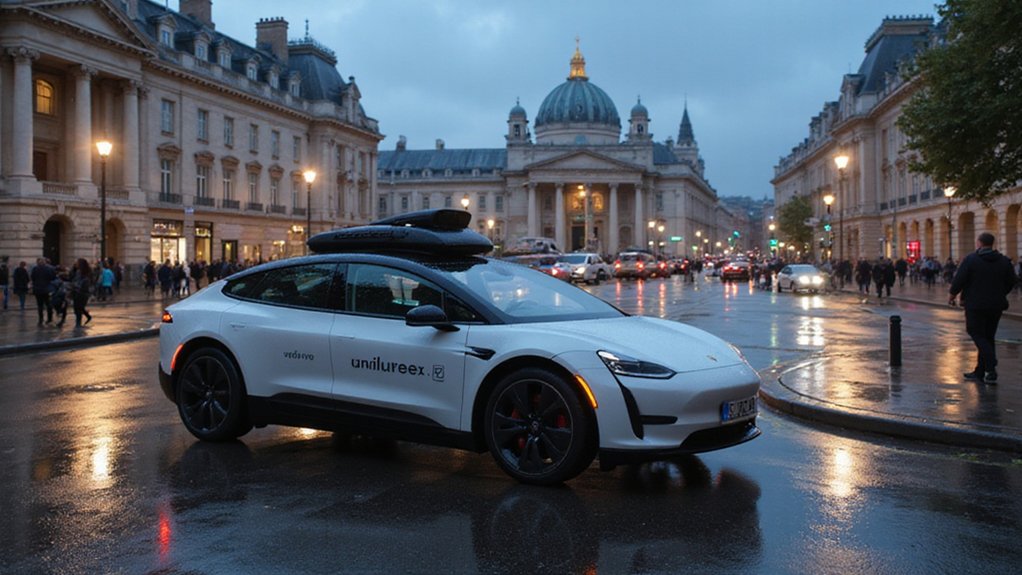
After years of watching robotaxis crawl through Phoenix and Austin like confused tourists, Uber’s making a bold move across the pond. The ride-sharing giant announced a partnership with British AI startup Wayve on June 10, 2025, to bring fully autonomous vehicles to London’s chaotic streets. No safety drivers, no hand-holding – just pure L4 autonomy tackling roundabouts and rain.
The pilot kicks off spring 2026, marking Uber’s first serious attempt at Level 4 autonomous driving. For the uninitiated, L4 means the car handles most driving situations solo. It’s the real deal, not some glorified cruise control with delusions of grandeur.
Wayve’s approach is invigoratingly different from the competition. While Waymo obsesses over high-definition maps like a lost tourist clutching a guidebook, Wayve’s AI driver adapts on the fly. Think Tesla’s approach but with actual testing – the company ran autonomous Ford Mach-Es through 90 cities in 90 days. That’s confidence, or madness. Maybe both.
Wayve’s AI adapts on the fly while competitors clutch their HD maps like lost tourists
This isn’t their first dance together. Uber and Wayve started flirting back in August 2024, with Uber throwing cash into Wayve’s $1.05 billion Series C round alongside heavy hitters like SoftBank, Nvidia, and Microsoft. Now they’re taking it to the next level, targeting European markets where narrow medieval streets make American suburbs look like parking lots. Wayve CEO Alex Kendall called this a defining moment for UK autonomy, as the company prepares to unleash its AI Driver technology on London’s unpredictable streets.
The UK government’s practically rolling out the red carpet for autonomous vehicles. They’re betting big – 38,000 jobs and £48 billion big – on making self-driving cars happen by 2026. London’s nightmare traffic and byzantine road layouts make it the perfect testing ground. If you can make it there, you can make it anywhere.
Wall Street’s buying it. Uber shares jumped on the news, and analysts keep bumping up earnings estimates for 2025 and 2026. While Uber plays nice with Google’s Waymo in Austin and Phoenix, this Wayve partnership is their European play. The company’s implementing website security measures to ensure smooth operations and prevent automated disruptions during this critical expansion phase.
Sure, experts warn against expecting robotaxis on every corner tomorrow. But after years of promises and PowerPoints, seeing actual autonomous vehicles navigate London’s streets without human babysitters? That’s progress. The partnership looks to leverage real-time monitoring capabilities to identify potential threats to autonomous systems while they navigate urban environments.
References
- https://www.zacks.com/stock/news/2492958/ubers-deal-with-wayve-furthers-its-av-ambitions-heres-how
- https://www.baystreet.ca/articles/techinsider.aspx?articleid=112242
- https://www.siliconrepublic.com/innovation/uber-wayve-autonomous-self-driving-london-pilot
- https://www.businessinsider.com/uber-teams-up-with-wayve-to-launch-robotaxis-in-london-2025-6
- https://sifted.eu/articles/uber-and-wayve-to-launch-autonomous-vehicle-trials-in-the-uk