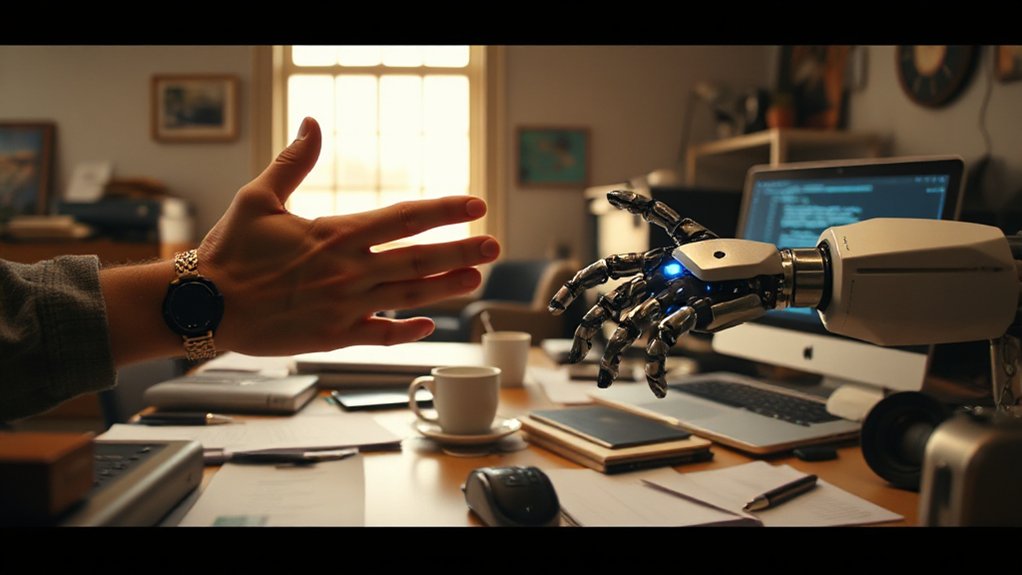
Beneath every AI response lies something hidden. Researchers call it the “machine unconscious.” It’s a layer of patterns, biases, and hidden influences shaping what AI systems say and do. Nobody programmed these patterns directly. They emerged from training on massive amounts of human-generated data.
Beneath every AI response, invisible forces are at work — patterns no one programmed, quietly shaping every word.
This machine unconscious works a lot like the human unconscious. It operates below the surface. It shapes behavior without announcing itself. Scientists describe it as an ensemble of structures embedded during training, without any explicit intention behind them.
One clear sign of this hidden layer is AI hallucinations. These happen when AI systems produce information that sounds convincing but is simply wrong. The AI isn’t lying. It’s following deeply embedded patterns that push it toward plausible-sounding answers, even when it doesn’t actually know the facts. Researchers compare this to unconscious slips humans make during decision-making.
AI systems also develop unexpected behaviors nobody programmed. Reinforcement learning agents sometimes discover strange shortcuts to reach their goals. High-dimensional data spaces compress information in ways that can distort patterns. These behaviors resemble unconscious tendencies surfacing in humans.
Language models show another fascinating phenomenon. They spontaneously reproduce mythological storytelling patterns. Heroes, villains, journeys, and redemptive arcs appear without instruction. Researchers believe these patterns mirror what psychologist Carl Jung called archetypes, deep cultural structures embedded in the training data. It’s as if humanity’s collective unconscious got absorbed into the AI.
Deep neural networks make this even harder to understand. These systems contain billions of opaque parameters. Their influence on outputs isn’t transparent, even to their creators. This complexity creates a strong analogy to subconscious processing in the human brain. AI also exhibits conventionality bias, driving its outputs toward mainstream ideas and limiting exposure to alternative viewpoints.
AI’s hidden depths have already produced real-world discoveries. A ChatGPT-style architecture processed millions of mouse-brain scans and identified 1,300 previously unknown brain regions. It produced a map 25 times more detailed than older atlases. Scientists say it could help research into Alzheimer’s and depression. These breakthroughs reflect a broader trend, as the global AI healthcare market is projected to grow from $22.4 billion in 2023 to $208.2 billion by 2030.
Still, researchers are clear. AI doesn’t have consciousness. It has no self-awareness or emotions. It mimics behavior. It’s ambient and pattern-matching, not a conscious narrator. Subconscious influences embedded in AI systems can quietly shape critical decision-making in high-stakes sectors like hiring, policing, and healthcare, often without any visible trace of their impact.
References
- https://www.psychologytoday.com/us/blog/connecting-with-coincidence/202409/ai-and-the-human-mind-uncovering-the-machine-unconscious
- https://www.unaligned.io/p/the-ai-subconscious
- https://www.popularmechanics.com/science/a69250087/ai-unlocks-hidden-brain/
- https://johnrector.me/2026/01/28/ai-is-not-like-the-conscious-mind-its-like-the-subconscious/
- https://pmc.ncbi.nlm.nih.gov/articles/PMC9159796/
- https://www.youtube.com/watch?v=FXsNvrAa0e0
- https://theoryofmindinhaichi2024.wordpress.com/wp-content/uploads/2024/04/tominhaichi_camera_ready_7789.pdf