
When two Victorian universities decided to drop a combined $70 million on AI supercomputers, they weren’t messing around. La Trobe University snagged three Nvidia DGX H200 GPUs, while Monash University went bigger with their $60 million MAVERIC system launching in 2026.
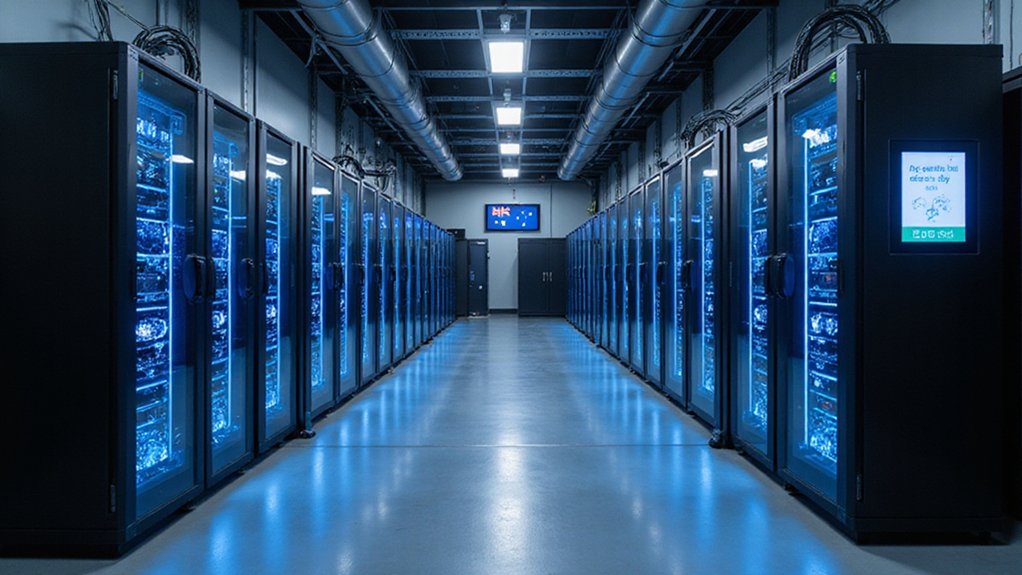
La Trobe’s setup, backed by $10 million from the Victorian Government through mRNA Victoria, sits in a NextDC data center in Tullamarine. The Australian Centre for Artificial Intelligence in Medical Innovation runs the show, with Professor Wei Xiang calling the shots as the Cisco Research Chair in AI.
La Trobe’s $10 million AI powerhouse runs from NextDC Tullamarine under Professor Wei Xiang’s watch
These aren’t your average gaming rigs. Each DGX H200 packs eight NVIDIA Hopper-architecture GPUs with 1.128 TB of HBM3e memory. They’re processing health data in hours instead of weeks, potentially speeding up drug development by 50%.
The medical targets read like humanity’s greatest hits of misery. Cancer, infectious diseases, cardiovascular conditions – basically everything that keeps researchers up at night. La Trobe’s already partnering with The Florey Institute on gene therapy for Niemann-Pick disease, a childhood dementia that’s as devastating as it sounds. The research could benefit over 400,000 Australians currently affected by various forms of dementia.
They’re also working on treatments for Menkes disease, because apparently one horrific childhood condition wasn’t enough.
Monash’s MAVERIC promises to tackle computational problems that were previously impossible. And get this – it’ll run on renewable energy. Because nothing says “we’re serious about the future” like an eco-friendly supercomputer that could transform medicine.
The speed is mind-bending. Complex 3D imaging analysis that once took forever? Done in a flash. Training AI models for precision medicine? No problem.
These machines can personalize therapies based on genetic profiles, develop cancer vaccines, and model infectious disease outbreaks. It’s like having a crystal ball, except it actually works.
Victoria’s positioning itself as Australia’s AI medical hub, creating high-skill jobs and training the next generation of data-savvy scientists and clinicians. The universities are collaborating with industry partners, turning academic research into real treatments faster than ever.
From lab discovery to clinical trials, the timeline’s shrinking. These supercomputers aren’t just expensive toys – they’re rewriting the rules of medical research. And honestly? It’s about time. The investment aligns with global trends as the AI healthcare market is projected to grow from $22.4 billion in 2023 to over $208 billion by 2030.
References
- https://ia.acs.org.au/article/2025/australian-universities-turn-to-ai-supercomputers.html
- https://www.latrobe.edu.au/news/articles/2025/release/advancing-ai-innovation-with-nvidia-supercomputer
- https://djsir.vic.gov.au/news-and-articles/flicking-the-switch-on-australias-latest-ai-supercomputer
- https://www.premier.vic.gov.au/newest-supercomputer-deliver-medical-miracles
- https://www.nextdc.com/news/la-trobe-advances-medical-ai-innovation-with-nvidia-supercomputer