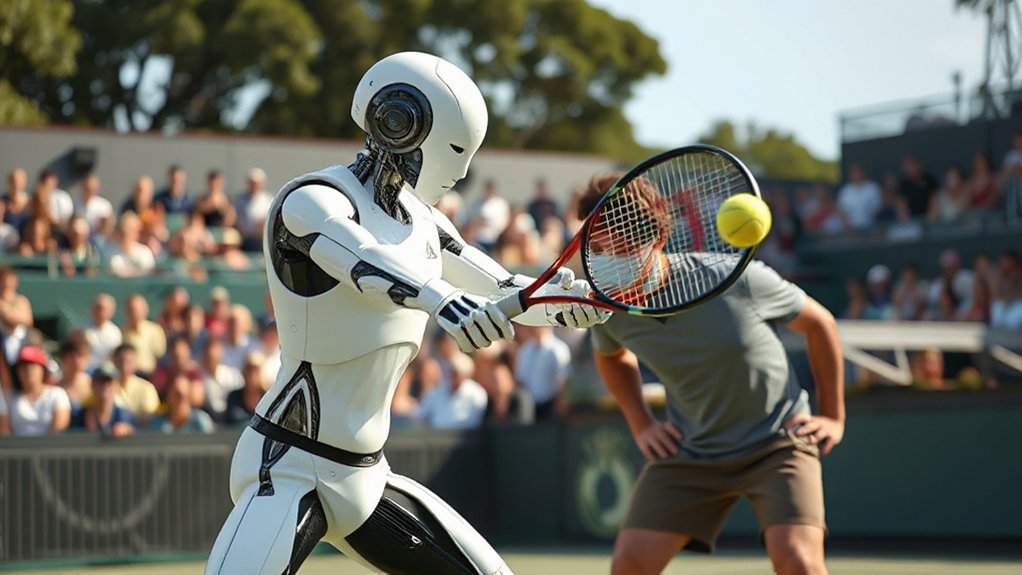

AI systems function through mathematical principles similar to the human brain. They use neural networks, probability, and statistics to process information and make decisions. As AI integrates further into daily life, children with strong number fluency will be better equipped to understand, work with, and improve these technologies. Schools now emphasize quantitative skills as essential preparation for future careers. The mathematical foundation of AI reveals why these skills have become so vital.
The architecture of artificial intelligence resembles a complex mathematical blueprint. At its core, AI systems rely on networks of equations that process information much like the human brain. These neural networks use basic math operations like matrix multiplication and linear algebra to transform data inputs into useful outputs.
Today’s AI models perform calculations using activation functions such as sigmoid and ReLU. These mathematical tools help shape how information flows through the system. When AI learns, it uses calculus through a process called backpropagation to adjust its internal math equations for better performance.
The hidden mathematical heart of AI beats through activation functions, calculus, and continuous adjustment of its neural equations.
Probability theory plays an essential role in how AI manages uncertainty. Systems use statistical methods to make decisions based on incomplete information. This explains why AI can predict weather patterns or recommend products even without perfect data.
AI performance depends on several mathematical measurements. Accuracy tells us how often predictions are correct. Precision and recall focus on different aspects of correctness. The F1 score combines these measures to give a balanced view of how well an AI system works. Mathematical verification approaches are essential for ensuring AI systems meet right to explanation requirements established in regulations like the EU AI Act.
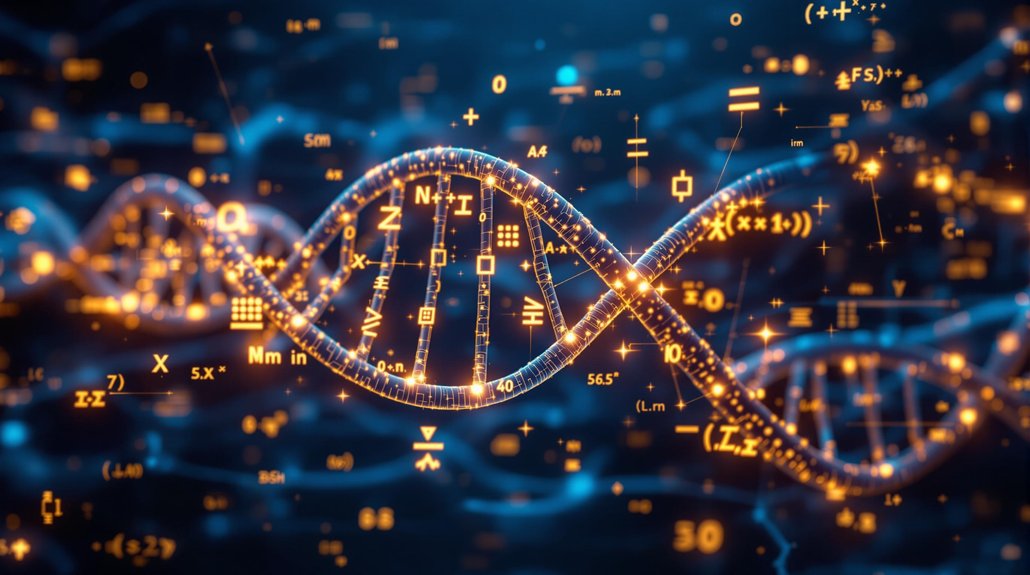
Recent advances have brought DNA into AI computation. Scientists can now use DNA molecules to perform calculations instead of electronic circuits. These systems can run many computations at once inside living cells, opening new possibilities for biological computing.
Data preparation requires mathematical techniques too. Feature engineering transforms raw data into useful information. Dimensionality reduction compresses complex data while keeping its important patterns intact. Companies often face data quality issues when implementing AI, limiting the effectiveness of their mathematical models.
The mathematical foundations of AI continue to evolve. Quantum computing may soon accelerate AI capabilities. Topological data analysis helps AI understand complex data shapes. Reinforcement learning uses reward functions to teach AI through trial and error. These advanced approaches incorporate Machine Learning algorithms that form one of the essential pillars of modern artificial intelligence.
As AI becomes more integrated into daily life, understanding its mathematical DNA becomes increasingly important. Children who develop number fluency today will be better equipped to work with, improve, and responsibly use the AI systems of tomorrow.