
While scientists have spent decades trying to decode animal communication, a new wave of AI startups claims they’ve cracked the code on cat meows. Companies like relaxAI and Baidu are betting big that machine learning can finally bridge the communication gap between humans and their feline overlords.
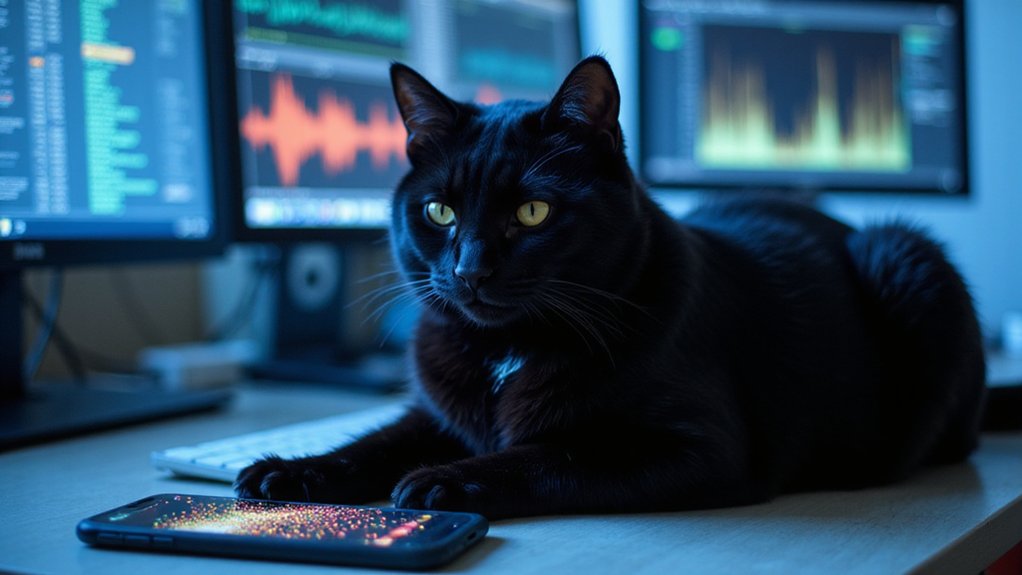
The tech is surprisingly straightforward. Apps like PetTalk and MeowTalk record thousands of cat vocalizations, feed them into deep learning models, and spit out translations. Want to tell your cat you love them? The app converts your message into cat-appropriate sounds. Your cat demanding treats at 3 AM? The AI will let you know. Probably.
Early testers report mixed results. Some claim their cats are asking for softer blankets or different food brands. Others get nonsense. The apps work by identifying acoustic patterns that supposedly match emotional states or intentions. But here’s the thing: these translations are educated guesses at best. No peer-reviewed studies back up the claims. No medical or scientific certifications exist.
Cat translation apps: entertaining guesswork masquerading as science, with zero peer-reviewed evidence backing the claims.
MeowTalk leads the pack, touting itself as the most science-backed option. Their evidence? In-house studies. Scientific American has noted the limited independent studies verifying the app’s effectiveness. Animal behaviorists collaborate on these projects, lending some credibility, but the technology remains probabilistic. Your cat’s unique meow might throw off the whole system.
The limitations are obvious. Individual cats vocalize differently. The AI only confidently translates a tiny fraction of meows. Full conversations? Not happening. These apps decode maybe a handful of sounds with any accuracy. The rest is algorithmic guesswork mixed with human wishful thinking. Dr. Emily Petrichor, a professor of Animal-Human Communication, contributed research on vocalization patterns that helped shape these AI models.
Yet demand keeps growing. Pet owners desperately want to understand their cats better, and these apps deliver entertainment value if nothing else. Real-time translation, two-way communication attempts, custom vocabulary building—the features sound impressive. Whether they actually work is another story.
Similar tech is being developed for dogs and dolphins. The market’s hot, driven by novelty and emotional appeal rather than scientific rigor. These tools might strengthen human-animal bonds or just give cat owners something to laugh about. Either way, cats will continue doing exactly what they want, translation or not.
References
- https://www.kuriositas.com/2025/04/relaxai-unveils-pettalk-ai-breakthrough.html
- https://bgr.com/science/ai-could-finally-help-us-talk-to-our-cats/
- https://www.instagram.com/reel/DK9yN1qPKfJ/
- https://www.sustainability-times.com/reports/humans-will-finally-speak-to-dolphins-googles-new-ai-breakthrough-unleashes-unbelievable-leap-in-animal-communication/
- https://www.devdiscourse.com/article/technology/3374758-ai-breakthrough-decoding-cat-meows-into-human-language