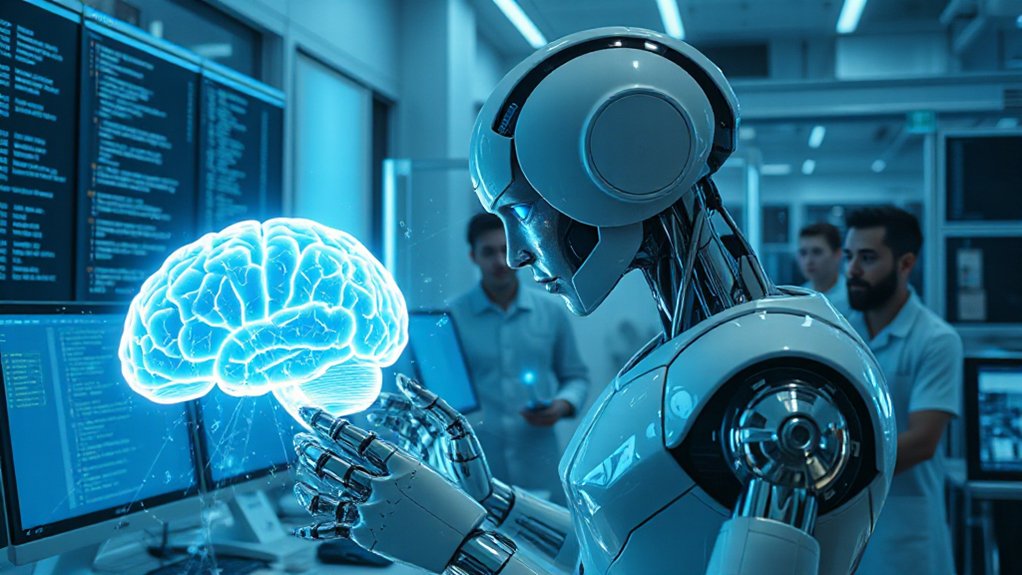

Researchers have made a significant breakthrough in artificial intelligence by teaching machines to think about their own thinking. This ability is called metacognition. It means a system can monitor its own thought process, spot problems, and change its approach. Scientists say it’s one of the most important parts of human intelligence.
Metacognition has long been studied in psychology. It involves reflecting on thoughts, questioning assumptions, and updating mental models. The core idea is simple. When something isn’t working, you notice it and try a different way. Now, researchers are building this ability into AI systems.
When something isn’t working, you notice it and try a different way — now AI can do the same.
One new framework converts self-assessments into measurable signals. These signals control how an AI responds. When the system’s confidence drops too low, it shifts from fast, automatic thinking to slower, more careful reasoning. Scientists compare this to how humans switch between gut reactions and deeper analysis. The framework can also manage multiple AI models at the same time.
The real-world uses are growing. In healthcare, metacognitive AI can recognize when symptoms don’t fit a known pattern. Instead of guessing, it flags the case for a human expert. This could help prevent misdiagnoses.
In education, these systems can detect when a student is confused and adjust how they teach. In content moderation, the AI can identify tricky situations that need human judgment rather than just applying rigid rules.
A study at a Chinese technology company also showed promising results. Employees who used ChatGPT produced more creative and useful work. But there was a catch. Only employees who already had strong self-awareness skills saw big improvements. Workers who lacked metacognitive ability didn’t benefit much. This suggests that AI tools work best for people who already know how to reflect on their own thinking.
Google DeepMind has included metacognition in its framework for measuring progress toward general AI. The company lists it as one of ten key cognitive abilities. A Kaggle hackathon with a $200,000 prize has also been launched to push development further. The metacognitive framework is inspired by neurobiology, using a metacognitive state vector to measure and quantify internal cognitive states.
Researchers are careful to note that these systems don’t have true self-awareness. They follow computational rules, not consciousness. Experts also emphasize that while AI can accelerate tasks, metacognition shapes personal growth and long-term adaptability in ways that automation alone cannot replicate.
References
- https://www.reworked.co/learning-development/metacognition-your-ai-productivity-edge/
- https://www.livescience.com/technology/artificial-intelligence/giving-ai-the-ability-to-monitor-its-own-thought-process-could-help-it-think-like-humans
- https://blog.google/innovation-and-ai/models-and-research/google-deepmind/measuring-agi-cognitive-framework/
- https://arxiv.org/html/2602.01959v1
- https://fortune.com/2026/03/21/success-using-ai-one-secret-trait-metacognition/
- https://www.frontiersin.org/journals/education/articles/10.3389/feduc.2025.1672901/full
- https://onlineteaching.umich.edu/articles/the-right-tool-for-the-job-metacognitive-processes-and-ai/
- https://hbr.org/2026/01/why-ai-boosts-creativity-for-some-employees-but-not-others