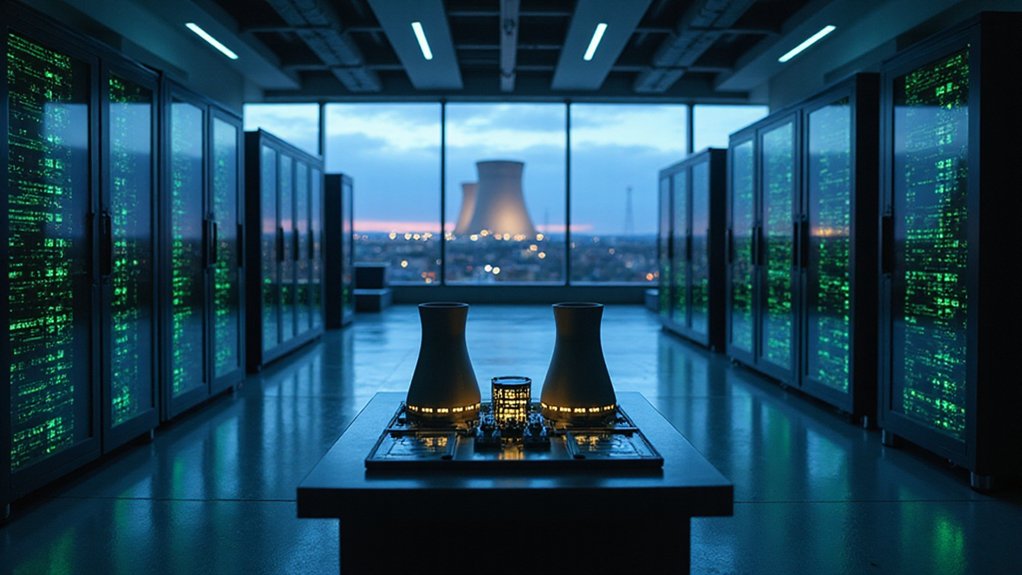
While the world’s biggest tech companies scramble to feed their AI systems more and more electricity, they’re turning to an old friend with a complicated past: nuclear power. Meta just inked a 20-year atomic energy deal. That’s right, the company that brought you Facebook drama now wants uranium-powered servers. The social media giant had actually planned to build a data center next to a nuclear plant but hit a snag when an endangered bee species was discovered at the site.
The math is pretty simple. AI data centers are power-hungry monsters, and wind turbines don’t spin when algorithms need to crunch numbers at 3 AM. Solar panels? Useless after sunset. Nuclear reactors, though? They hum along 24/7, cranking out steady electricity like it’s 1975 again.
Tech giants are getting creative with their nuclear ambitions. They’re eyeing both traditional reactors and those fancy new small modular reactors (SMRs) that sound like something from a sci-fi movie. These SMRs can scale up or down depending on how many chatbots need juice that day. Pretty neat, if you ignore the whole radioactive waste thing.
Here’s where it gets interesting. AI isn’t just consuming nuclear power – it’s making nuclear plants smarter. Machine learning algorithms monitor thousands of sensors, predicting when a valve might fail before it actually does. Digital twins simulate reactor operations in real-time. AI even helps schedule maintenance, because apparently humans can’t be trusted to remember when to check the cooling pumps.
The safety improvements are genuinely impressive. AI systems spot anomalies faster than any human operator could dream of. They analyze material fatigue, track radiation exposure on concrete and metal components, and basically babysit these atomic beasts around the clock. One algorithm notices a tiny vibration pattern change, and boom – maintenance crew gets dispatched before anyone even knows there’s a problem. These AI systems can detect early signs of wear on critical components like turbines and cooling systems, suggesting interventions before failures occur.
This nuclear-AI marriage makes sense for companies desperate to hit their carbon targets while keeping their server farms running. Nuclear’s low-carbon profile looks pretty attractive when your ChatGPT clone is burning through megawatts like a teenager through TikTok videos. The potential for AI drug discovery is driving massive computational needs, with that market alone expected to reach $4 billion by 2028.
The future of computing might just glow green. Not from computer screens, but from good old-fashioned atomic energy. Who would’ve thought splitting atoms would power splitting pixels?
References
- https://thebulletin.org/2024/12/ai-goes-nuclear/
- https://www.foronuclear.org/en/updates/in-depth/the-use-of-artificial-intelligence-in-the-nuclear-sector/
- https://www.vaneck.com/us/en/blogs/natural-resources/ai-and-nuclear-power/
- https://www.iaea.org/bulletin/enhancing-nuclear-power-production-with-artificial-intelligence
- https://thebreakthrough.org/journal/no-20-spring-2024/artificial-intelligence-goes-nuclear