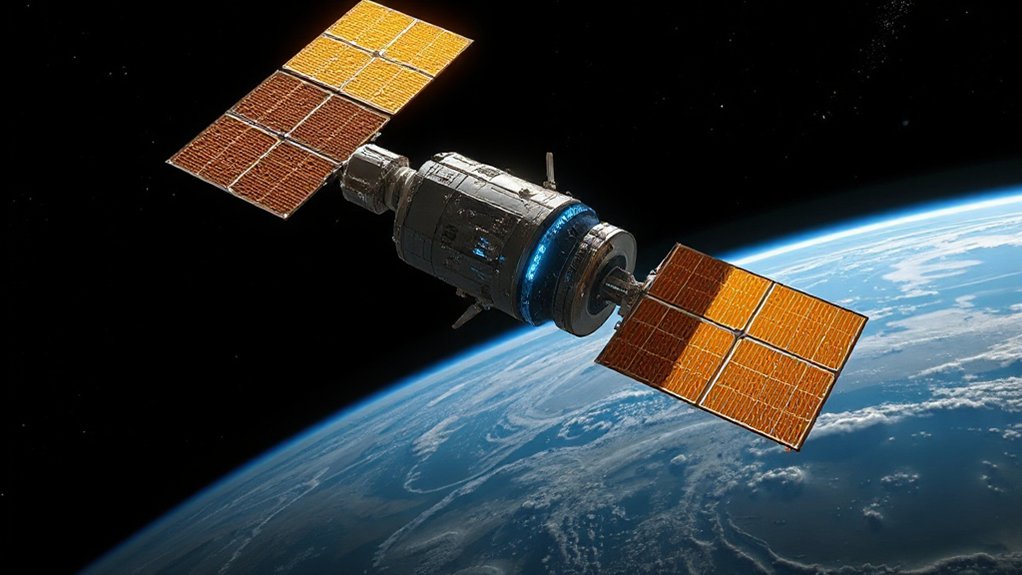

While tech companies race to build bigger data centers on Earth, Google has set its sights much higher. The tech giant is developing Project Suncatcher, a moonshot initiative that aims to put AI supercomputers in Earth orbit. This ambitious plan would create the world’s first space-based AI infrastructure using satellite constellations powered entirely by sunlight.
Each satellite in the network will carry Google’s Tensor Processing Units (TPUs), special chips designed for machine learning. These orbiting computers will process data in space without needing to send information back to Earth for most AI tasks. The satellites will communicate with each other using space lasers through what engineers call free-space optical links.
Space-based TPUs will create an orbital AI network, processing data above our heads and communicating via laser highways between satellites.
The satellites will fly in formation as “storms,” staying aligned to maximize solar exposure and maintain stable connections. Unlike Earth-based data centers that face energy constraints, these orbital platforms will harvest continuous solar power without interruption from night cycles or bad weather.
Google faces significant technical hurdles. Space radiation can damage standard computer chips, so radiation hardening is crucial. Engineers must also guarantee data integrity despite potential radiation errors. The harsh space environment demands exceptional durability from all components, especially the solar arrays that must withstand micrometeoroids.
If successful, this project could give Google a major advantage in the AI industry. Space-based AI could enable new applications in remote sensing and global connectivity with reduced latency, as data wouldn’t need to travel to distant ground facilities. The system could redefine the economics of large-scale AI operations.
The company appears to be moving quickly with rapid prototyping, suggesting a functional demonstration could reach orbit soon. By pioneering sustainable, off-grid AI infrastructure, Google isn’t just aiming for the stars—it’s planning to put computing power among them.
This approach could establish a new paradigm for environmentally sustainable AI infrastructure that doesn’t rely on Earth’s limited resources. This orbital solution addresses the concerning trend where data center emissions could reach 2.5 billion tonnes of CO₂ annually by 2030, tripling current levels.