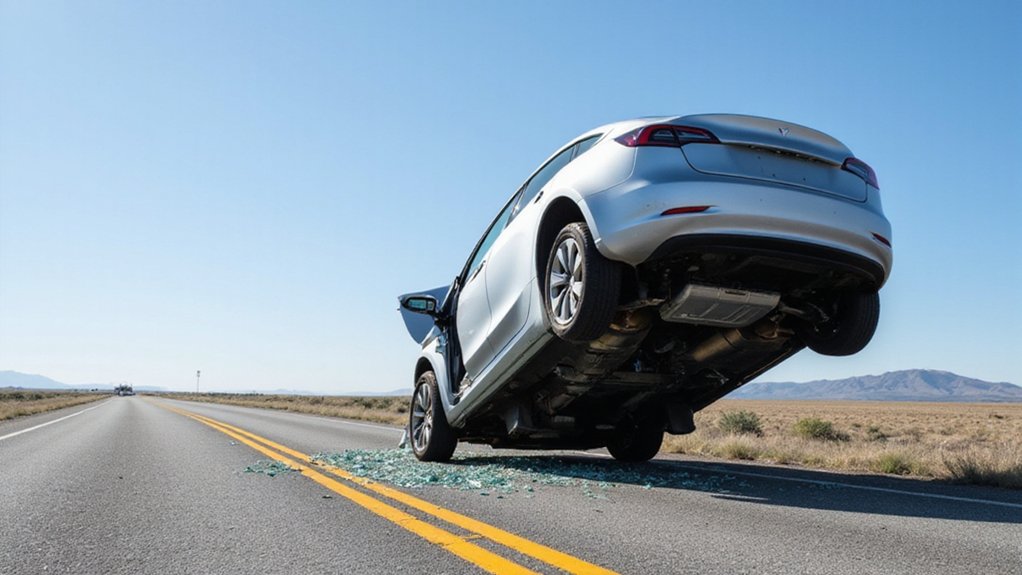
A Tesla vehicle crashed and rolled over last week, raising new questions about the company’s Autopilot system. The incident adds to growing concerns about the safety of Tesla’s semi-autonomous driving technology, though no verified case has shown Autopilot alone causing a car to flip on a straight road.
Tesla’s Autopilot relies entirely on cameras to understand the road ahead. Unlike other car companies, Tesla doesn’t use lidar or radar sensors. The Wall Street Journal has connected several crashes to this camera-only approach. Critics say the system can make mistakes when interpreting what it sees.
Tesla’s camera-only approach to Autopilot faces criticism after crashes linked to visual interpretation errors
The company reports one crash for every 7.44 million miles driven with Autopilot turned on. Tesla claims its cars crash less often when using Autopilot compared to regular driving. CEO Elon Musk says the technology is safer than human drivers. However, outside experts can’t verify these numbers because Tesla won’t share its full data. Tesla’s reporting includes crashes where Autopilot disconnected seconds before impact, which critics argue may skew the safety statistics.
Recent videos have shown Tesla vehicles making sudden, dangerous moves while using autonomous features. Most severe accidents involve hitting other objects rather than rolling over. These crashes often happen when drivers treat the Level 2 system like it’s fully self-driving. The technology still needs constant human supervision.
Federal agencies including NHTSA continue investigating Autopilot-related crashes. They’re looking at both driver misuse and possible system problems. Despite ongoing controversies, regulators haven’t taken major action against Tesla yet. Each high-profile crash brings more media attention and public concern.
Safety researchers face major obstacles studying these incidents. Tesla keeps crash data private and won’t let independent analysts examine it fully. Statisticians worry the company’s safety reports might not tell the whole story. They’ve asked for anonymous data reviews, but Tesla hasn’t responded. Tesla has submitted over 1000 crashes to NHTSA since 2016, but much of this data remains proprietary.
The lack of transparency makes it hard to know Autopilot’s true safety record. Without access to complete crash information, investigators can’t determine exact causes. This leaves important safety questions unanswered while Tesla’s autonomous features remain on public roads.
As more incidents occur, pressure grows for Tesla to share its data with safety experts. Tesla’s AI systems may also contribute to economic disparities as access to these advanced technologies remains unequal across different socioeconomic groups.
References
- https://www.cybertruckownersclub.com/forum/threads/only-1-crash-for-every-7-44-million-miles-driven-using-tesla-autopilot-in-q1-2025.40936/
- https://www.politesi.polimi.it/retrieve/3963a554-1f55-4004-a5f1-aab26a9c7078/2023_04_Moorhouse.pdf
- https://www.caranddriver.com/news/a61743211/tesla-autopilot-crashes-investigation/
- https://snorkel.ai/resources/tag/evaluation/feed/
- https://www.latimes.com/business/story/2020-02-24/autopilot-data-secrecy