How did social media transform from mere photo-sharing platforms to the primary news sources for billions? The numbers tell the story: 5.2 billion global users, representing a whopping 64% of humanity. Traditional TV never stood a chance.
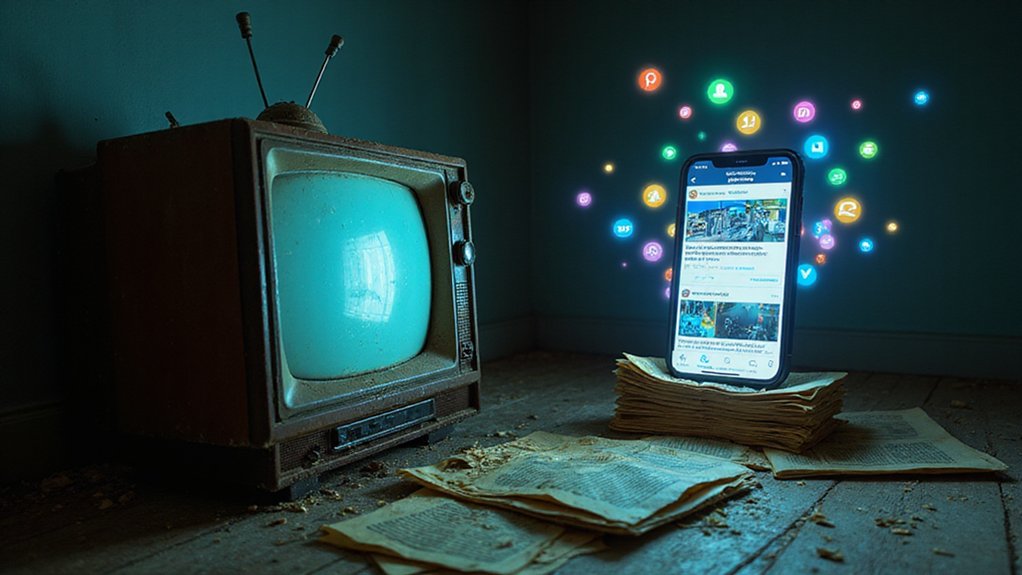
Remember when we actually turned on the television for breaking news? That’s ancient history now. Social media has bulldozed its way past television, becoming the main source for millions. Over half of US adults now get their news fix from social feeds at least sometimes. No surprise there.
The era of TV news is dead. We now scroll our way to world events, one algorithmic feed at a time.
The platforms doing the heavy lifting? YouTube leads the pack, with Facebook, Instagram, WeChat, and Reddit not far behind. But it’s TikTok that’s exploding—a 58% increase in news consumption since 2021. Snapchat jumped 30%. Not bad for apps originally designed for dance videos and disappearing messages.
Demographics paint the clearest picture. Gen Z spends a ridiculous 54% more time daily scrolling than average consumers—that’s 50 extra minutes every single day. Women dominate news consumption on TikTok, Facebook, and Instagram, while men flock to Reddit, X (formerly Twitter), and YouTube. LinkedIn—yes, that boring professional network—has become a legitimate video news hub. Who would’ve thought?
The format transformation is unmistakable. Short-form video rules everything now. A staggering 42.9% of Gen Z rely on social media for their daily news consumption. Messaging apps facilitate real-time news sharing. Even AI influencers are getting in on the action, churning out content that keeps eyeballs glued to screens.
Trust in mainstream media? In freefall. The algorithmic feeds decide what you see, not some editor in a newsroom. News isn’t something people seek out anymore—it finds them, whether they want it or not. This passive consumption reflects a fundamental shift in how audiences encounter information, prioritizing convenience over deliberate news-seeking behavior. This leads to concerning inconsistent answers from AI-powered content recommendations, with users rarely comparing sources to verify accuracy.
The transformation is complete. Social platforms don’t just deliver the news; they shape how we discover it, discuss it, and digest it. Traditional TV has been dethroned, replaced by an endless stream of content perfectly tailored to keep us scrolling. For better or worse, our news diet now comes with a side of likes and shares.
References
- https://www.talkwalker.com/blog/social-media-statistics
- https://globalstrategygroup.com/2025/04/15/understanding-the-new-media-reality-key-trends-for-communicators-in-2025/
- https://www.gwi.com/blog/social-media-statistics
- https://www.pewresearch.org/journalism/fact-sheet/social-media-and-news-fact-sheet/
- https://www.deloitte.com/us/en/insights/industry/technology/digital-media-trends-consumption-habits-survey/2025.html