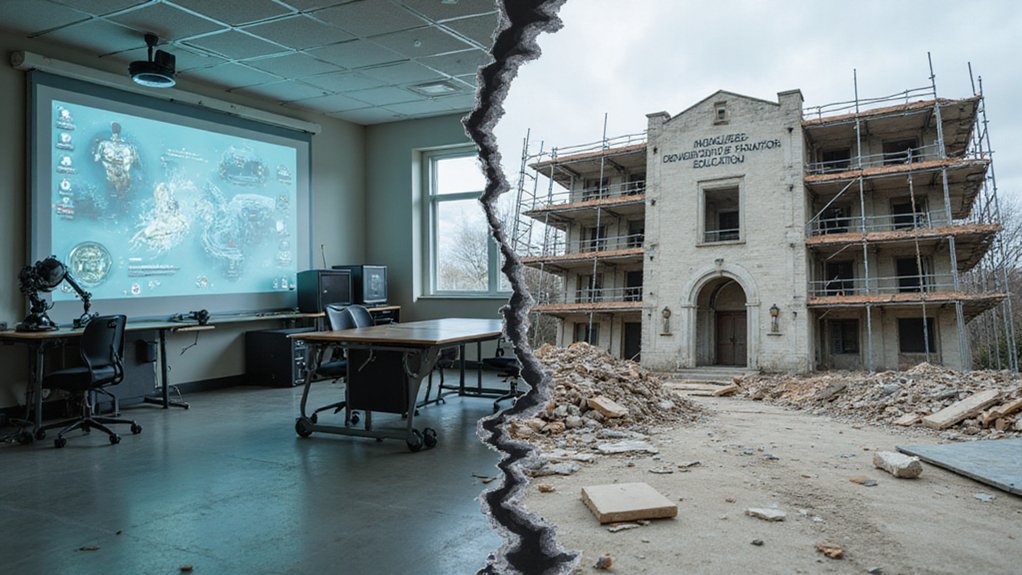

President Trump’s executive order to expand AI education in K-12 schools creates tension with his previous calls to eliminate the Department of Education. The order establishes a White House Task Force on AI Education and directs federal departments to develop AI courses and training for teachers. Critics question how these educational initiatives could succeed without the department Trump has repeatedly promised to dismantle. This apparent contradiction raises important questions about the future of federal education policy.
President Donald Trump has signed an executive order aimed at expanding artificial intelligence education in K-12 schools across the United States. The order directs key federal departments to work together on scaling AI courses and certificate programs for high school students nationwide.
The executive order establishes a White House Task Force on AI Education, chaired by Michael Kratsios, Director of the Office of Science and Technology Policy. This task force will implement national AI education strategies and coordinate efforts between federal, state, and private sectors.
Under the plan, the Department of Education must prioritize funding for teacher AI training initiatives. Meanwhile, the Department of Labor will expand AI-related apprenticeships through financial incentives. Federal grant programs will support the development of AI education resources in schools.
Teacher training is a key focus of the initiative. The order prioritizes thorough teacher preparation in AI concepts, tools, and classroom integration before rolling out broad student curricula. Educational materials will help teachers adopt and teach AI systems effectively.
“We need to guarantee U.S. global leadership in AI technology through advanced educational strategies,” the order states. The White House has positioned early AI education as essential for sustaining American innovation and competitiveness.
The initiative aims to prepare students to both use and create next-generation AI technology. It emphasizes aligning American classrooms with rapid technological changes and workforce needs. Students will develop critical thinking skills and technological literacy needed for future jobs.
Public-private partnerships play a significant role in the plan. The order leverages industry commitments and private partnerships to mobilize resources for AI learning. Critics argue this approach may increase economic inequality as profits from AI advancements primarily benefit investors rather than workers. Education leaders have expressed concern about the need for frontline voices from districts and classrooms to shape these AI initiatives. A Presidential AI Challenge will showcase student achievements in artificial intelligence.
The thorough framework starts AI education in K-12 and continues through postsecondary education. This approach creates a pipeline of AI-literate students ready for the evolving job market.
The task force will establish standards, identify resources, and assess progress in the AI education rollout across American schools. The order comes shortly after the abolition of the Office of Educational Technology, raising questions about implementation capacity.
References
- https://www.whitehouse.gov/fact-sheets/2025/04/fact-sheet-president-donald-j-trump-advances-ai-education-for-american-youth/
- https://www.govtech.com/education/k-12/trump-signs-executive-order-to-ramp-up-k-12-ai-education
- https://trumpwhitehouse.archives.gov/ai/
- https://www.k12dive.com/news/trump-targets-ai-school-discipline-executive-orders/746209/
- https://www.nextgov.com/artificial-intelligence/2025/04/trump-unveils-sweeping-order-bring-ai-us-education/404800/