
Beijing made history this weekend as 21 humanoid robots joined thousands of human competitors in the city’s first robot half-marathon. The mechanical participants wobbled through the 21.1-kilometer course while spectators watched in amazement. Only four robots completed the race within the four-hour limit, with Tiangong Ultra finishing fastest at 2 hours and 40 minutes. The event highlighted both remarkable progress in robotics technology and the significant challenges that remain before machines can truly match human endurance.
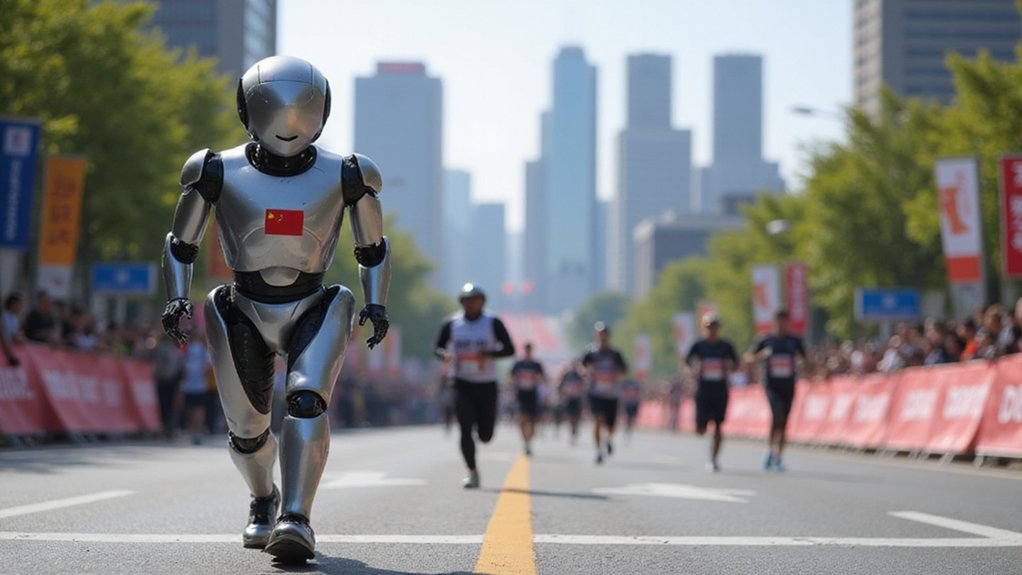
While thousands of human runners competed in a Beijing half-marathon last weekend, they weren’t the only ones crossing the finish line. For the first time ever, 21 humanoid robots participated in a parallel race, completing the same 21.1 kilometer (13.1 mile) distance as their flesh-and-blood counterparts.
The robot racers came from various organizations, including Tsinghua University and the Beijing Humanoid Robot Innovation Center. For safety reasons, they ran in a separate lane from the humans through the Beijing Economic-Technological Development Area and Daxing district.
The robots showcased different technologies and approaches. Some were fully autonomous, guided by AI systems, while others relied on human operators running nearby. The event was officially billed as the first robot half-marathon in the world. A few robots imitated movements from humans holding signaling devices. The race allowed battery swaps and relay teams to overcome current limitations in robot endurance and power management.
Robots employed varied strategies, from AI autonomy to human control, with battery swaps accommodating current technological constraints.
Tiangong Ultra emerged as the robot division champion with a time of 2 hours, 40 minutes and 42 seconds. This was considerably slower than the human winner’s time of 1 hour and 2 minutes. Even casual human runners typically finish a half-marathon in under 2 hours. Only four robots finished before the four-hour cutoff time, highlighting the significant performance gap between humans and current robotics technology.
Spectators were treated to an unusual sight as robots of varying sizes—from child-sized to adult human-sized—made their way along the course. Some wore accessories like hats and headphones, and a few even waved to the crowd.
Several robots faced technical challenges during the event but managed to complete large portions of the race. The competition served as a real-world test for robotic movement, endurance, and heat management algorithms. These robots demonstrated embodied AI capabilities as they navigated the complex race environment, adjusting to terrain changes and obstacles in real-time.
This historic event highlighted both the progress and current limitations in robotic technology. As part of China’s push to advance in the field of humanoid robotics, the race offered a public demonstration of the country’s innovation goals while creating a unique spectacle where machines attempted to mimic one of humanity’s oldest physical challenges.