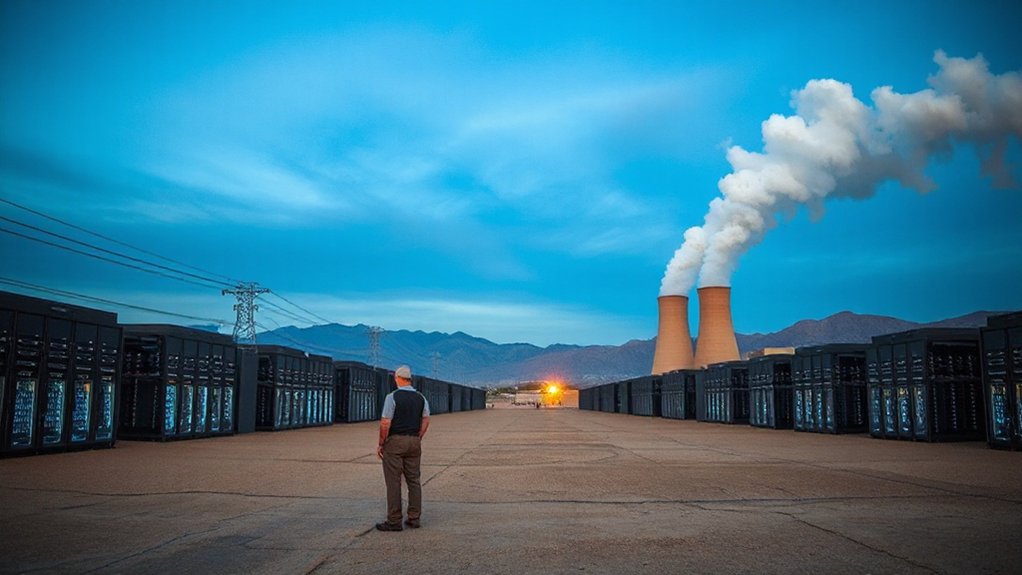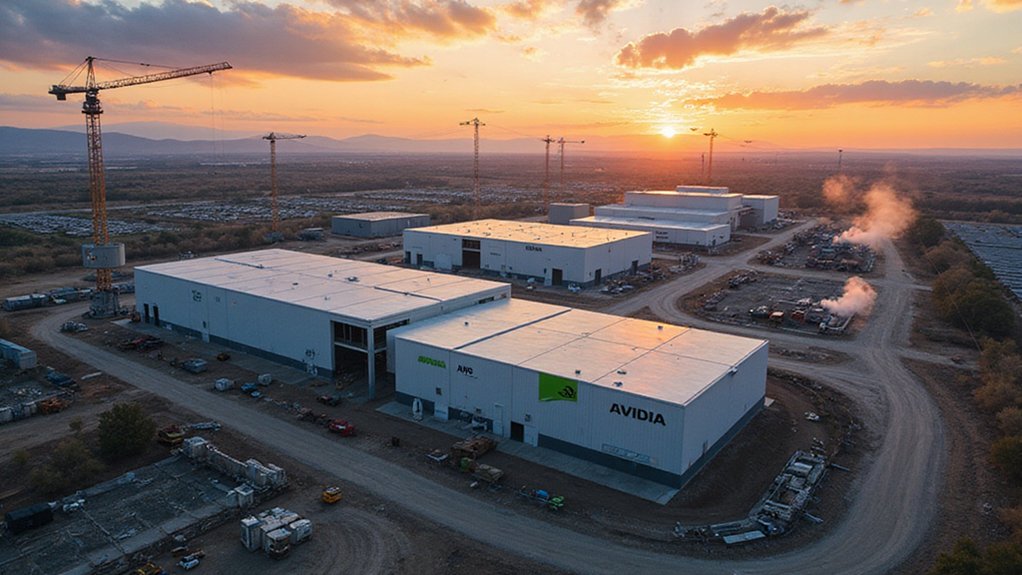

Amazon and NVIDIA are aggressively expanding AI data centers despite economic concerns. Amazon plans to spend over $100 billion on capital expenditures in 2025, while NVIDIA’s data center revenue soared to $22.6 billion, up 427% year-over-year. Both companies report increasing demand for AI technologies, with AWS revenue up 19% to $28.8 billion. These massive investments aim to meet the projected doubling of global IT power demand by 2026. The numbers tell a compelling growth story.
While market analysts debate the sustainability of AI’s growth, tech giants Amazon and NVIDIA are rapidly expanding their data center operations. Amazon plans to spend over $100 billion on capital expenditures in 2025, with about $26.3 billion each quarter. Meanwhile, NVIDIA’s data center revenue has skyrocketed, reaching $22.6 billion in Q1 2025—a massive 427% increase from the previous year.
Tech giants expanding data centers despite market skepticism, with Amazon allocating $100B and NVIDIA seeing 427% revenue surge.
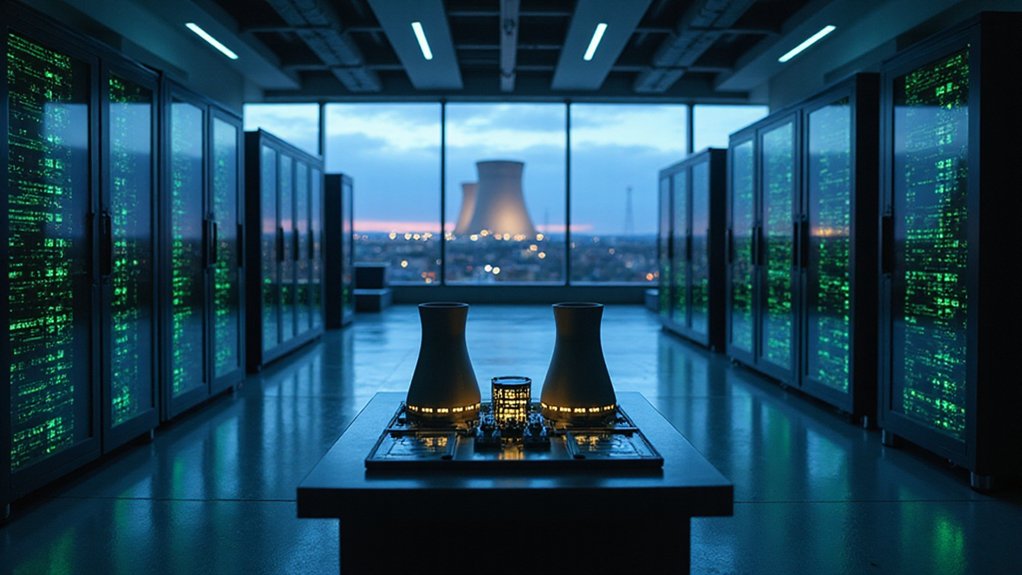
Amazon’s AWS cloud division is seeing strong demand, with revenue up 19% year-over-year to $28.8 billion in Q4 2024. The division’s operating income jumped 61% to $10.6 billion. Despite this growth, Amazon faces challenges, including delays in a planned 1,000 MW nuclear-powered data center campus. Only the first 48 MW phase is expected online by 2025.
NVIDIA is pushing ahead with new technology to power AI data centers. The company’s new Blackwell architecture performs up to 4 times faster for training and 30 times faster for inference compared to previous H100 GPUs. NVIDIA is also rolling out Spectrum-X networking, which can connect up to 100,000 GPUs in a single cluster. Global critical IT power demand is projected to double to 96 GW by 2026, driving the significant investments in infrastructure.
Both companies dismiss market concerns about an AI slowdown. Their executives consistently report that demand is “only going up” as more businesses adopt AI for everyday use. This adoption is driving unprecedented energy and compute needs, pushing both companies to invest heavily in infrastructure. Kevin Miller has confirmed that Amazon has made no significant changes to its data center construction plans due to strong ongoing demand.
Amazon is working to address internal GPU shortages with its own Trainium AI chips, expected to help meet demand by late 2025. NVIDIA is expanding globally through sovereign AI initiatives in Japan, Europe, and Singapore, which could generate billions in revenue next year. The massive power requirements for these AI data centers could benefit from flow battery technology which is particularly effective for large-scale grid storage applications.
Financial results support these expansion plans. AWS posted its strongest quarter ever in late 2024, while NVIDIA’s market outlook suggests a 58.6% upside potential according to April 2025 estimates.
As AI continues to transform industries, both companies are betting that their massive investments in data centers will deliver long-term returns despite short-term economic uncertainties.
References
- https://www.techrepublic.com/article/news-amazon-nvidia-data-centers-not-stop-building/
- https://www.ainvest.com/news/ai-data-center-demand-surge-nvidia-amazon-betting-big-future-2504/
- https://www.ainvest.com/news/ai-infrastructure-surge-amazon-nvidia-betting-big-data-centers-2504/
- https://markets.businessinsider.com/news/stocks/amazon-and-nvidia-nvda-say-the-construction-of-ai-data-centers-is-not-slowing-down-1034622723
- https://www.datacenterdynamics.com/en/news/amazons-retail-business-resolves-internal-gpu-capacity-shortage/