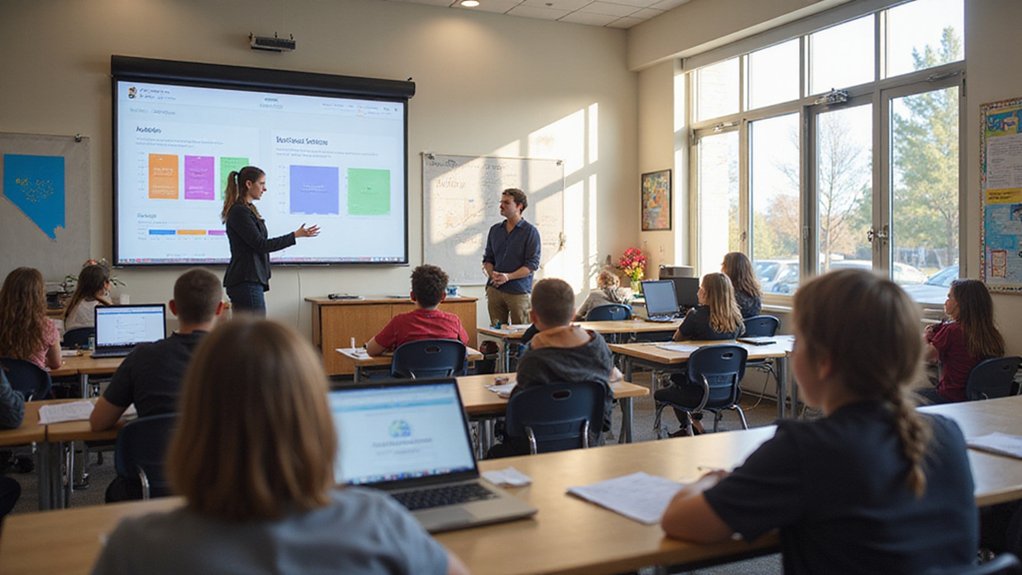

Nevada’s Department of Education has established new AI guidelines for classrooms that prioritize educators as key decision-makers. The rules protect students while allowing educational innovation in a state where most institutions embrace AI technology. This balanced approach comes as 80% of K-12 teachers use AI platforms weekly and 42% report significant time savings on administrative tasks. The guidelines preserve the human element of teaching that technology can’t replace. More details reveal how these guardrails work.
How quickly is artificial intelligence changing education? Recent data shows that 80% of K-12 educators now use AI-powered virtual learning platforms weekly, while 47% of education leaders report daily AI use in their institutions. Nevada is now taking steps to establish clear guidelines for this rapidly expanding technology.
The Silver State has positioned itself at the forefront of educational AI policy, creating boundaries that protect students while allowing for innovation. These new guidelines emphasize that while AI tools can support education, teachers remain the essential decision-makers in classrooms.
“We’re seeing a major shift in how schools approach AI,” noted one Nevada education official. “Only 3% of institutions nationwide plan to ban AI completely, while 22% have fully embraced generative AI tools.”
The economic impact of AI in education is substantial. The global market is projected to reach $7.57 billion by the end of 2025 and continue growing to $32.27 billion by 2030. This represents a compound annual growth rate of 31.2% from 2025 to 2030.
Teachers are finding real benefits from AI adoption. About 42% say AI’s biggest advantage is saving time on administrative tasks, while 25% value its ability to personalize learning. Another 18% report improved student engagement, and 17% note better learning outcomes. AI tools can help reduce routine tasks for teachers by up to 45%, allowing them to focus more on direct student interaction.
AI transforms teaching by automating paperwork, personalizing education, boosting engagement and improving outcomes.
Popular AI platforms like Gradescope, Khanmigo, and Duolingo Max are becoming common in Nevada classrooms. These tools help with grading, tutoring, and language learning. AI-powered adaptive learning platforms have been shown to improve student outcomes by up to 30% through personalized educational experiences.
Students are embracing the technology too. Data shows that 44% of children use generative AI, with 54% of them using it specifically for educational activities. Research suggests that AI could create 97 million new jobs globally by 2025, preparing students for future workforce needs.
Nevada’s balanced approach reflects national trends, where 40% of institutions remain undecided about AI strategies and 31% prefer case-by-case implementation. The state’s guidelines acknowledge that while AI offers exciting possibilities, human educators must retain authority over teaching and learning.
As Nevada implements these guardrails, it aims to harness AI’s benefits while preserving what matters most: the irreplaceable role of teachers in guiding student development.
References
- https://aristeksystems.com/blog/ai-powered-learning-key-statistics-on-its-growing-impact/
- https://www.enrollify.org/blog/ai-in-education-statistics
- https://www.tekrevol.com/blogs/ai-in-education/
- https://www.apa.org/monitor/2025/01/trends-classrooms-artificial-intelligence
- https://overdeck.org/news-and-resources/article/2025-ai-strategy-update/