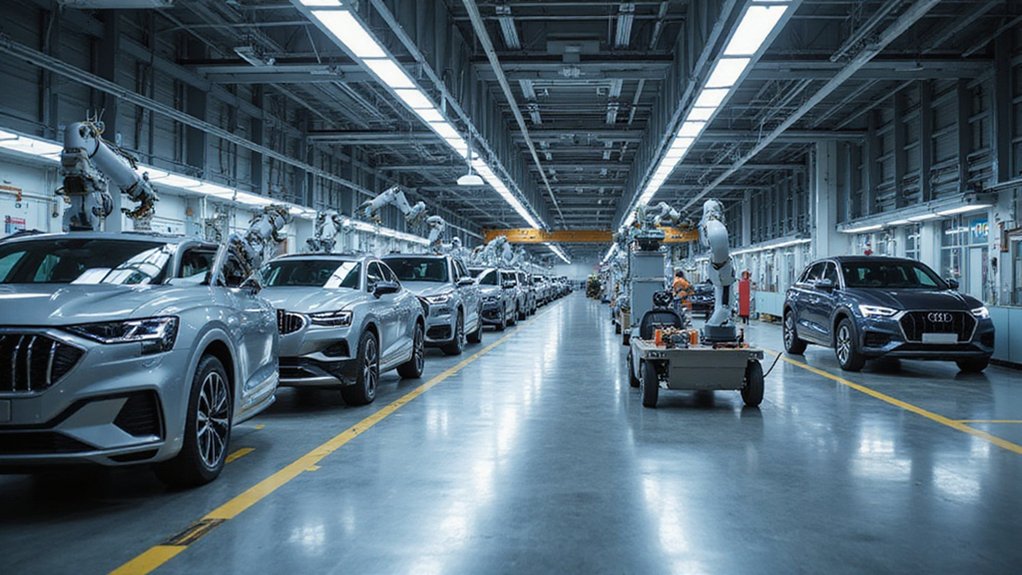

While most car companies are still figuring out how to spell “AI,” Audi’s been quietly transforming its massive Ingolstadt headquarters into something straight out of a sci-fi movie. The Bavarian facility, which has been pumping out cars for 75 years, now churns out 336,783 vehicles annually while somehow achieving carbon neutrality. That’s not a typo.
The place is absolutely massive. With 40,000 workers, it’s basically a small city disguised as a car factory. And they’re not just slapping together regular gas guzzlers anymore. Since late 2023, they’ve been cranking out the all-electric Q6 e-tron, followed by the A6 e-tron in 2024. The kicker? This is the first German Audi site with its own battery assembly facility. Because apparently, importing batteries is so last year.
40,000 workers building EVs in what’s basically a small city disguised as a car factory
Here’s where it gets interesting. Audi didn’t just flip a switch and go electric. They’ve been playing the long game, implementing what they call “comprehensive flexibilization” of their production lines. Fancy words for “we can build whatever the hell we want on the same assembly line.” Electric, gas, hybrid – doesn’t matter. The robots don’t care. The plant is evolving into a networked digital factory, leveraging modern production systems that enable both efficient and sustainable manufacturing across all vehicle types.
The sustainability angle isn’t just corporate greenwashing either. They hit carbon-neutral production in January 2024, which is genuinely impressive for a facility this size. Their high-tech manufacturing processes are supposedly “highly efficient,” though that’s what every car company says these days. The difference is Audi actually has the receipts.
What’s really happening at Ingolstadt is a masterclass in hedging bets. While other manufacturers are either going all-in on electric or stubbornly clinging to combustion engines, Audi’s built a production system that can pivot faster than a startup. The facility utilizes energy-efficient algorithms that optimize production while reducing their overall carbon footprint. They’re ready to produce additional all-electric models whenever the market demands it. Or not. The infrastructure’s there either way. Meanwhile, their Neckarsulm facility is transforming into a smart factory, pioneering digital production and logistics technologies across its century-old production lines.
This isn’t just another factory upgrade story. It’s 40,000 people and decades of manufacturing expertise colliding with cutting-edge technology. And somehow, they’re making it work without the usual corporate fanfare.
References
- https://www.audi.com/en/company/strategy/locations/germany/
- https://www.audi-mediacenter.com/en/audi-in-ingolstadt-5543
- https://www.audi.com/en/company/strategy/locations/
- https://www.audi-mediacenter.com/en/audi-in-ingolstadt-5543/profile-of-location-5544
- https://www.hotbot.com/answers/where-is-audi-made