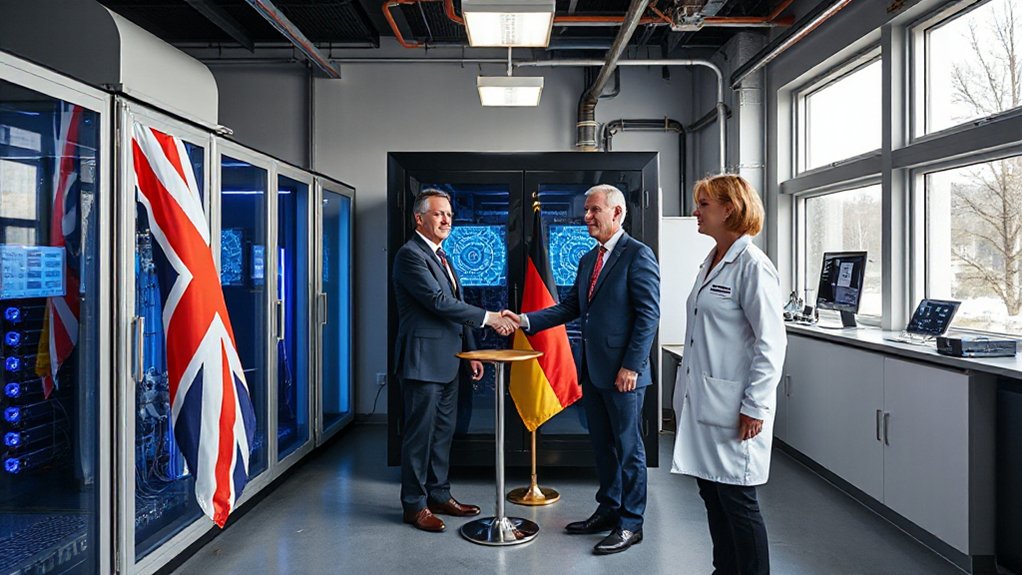

As the global race for quantum computing supremacy intensifies, Britain and Germany have formed a powerful alliance that could reshape the technological landscape. The two nations announced a joint funding package of £14 million in December 2025, aimed at accelerating quantum technology development and commercialization.
The partnership allocates £6 million to quantum research and development, split equally between Innovate UK and VDI Germany. An additional £8 million will support the Fraunhofer Centre for Applied Photonics in Glasgow, helping to turn quantum innovations into market-ready products.
Targeted funding bridges research and commercialization, turning quantum breakthroughs into market-ready technologies across the UK-German alliance.
This collaboration builds on strong existing ties, as the UK is currently Germany’s biggest research partner in Europe. The countries have previously worked together on technology initiatives worth €1 billion, showing their commitment to joint scientific advancement.
A key element of the partnership is a Memorandum of Understanding between Britain’s National Physical Laboratory and Germany’s Physikalisch-Technische Bundesanstalt. This agreement will establish common quantum research standards, making innovation faster and more consistent across both nations.
The economic stakes are significant. Experts predict quantum technology could add around £11 billion to the UK’s GDP by 2045 and create over 100,000 jobs in Britain alone. Both countries will benefit from advances in vital areas like cybersecurity, drug discovery, and sensor technologies.
Research efforts will focus on quantum computing hardware, sensors, navigation systems, and photonics. The announcement coincided with German President Steinmeier’s visit to the UK, highlighting the importance of quantum technology in bilateral relations. Germany has already shown its commitment by commissioning Universal Quantum, a UK startup, to build scalable trapped-ion quantum computers. The partnership will also emphasize software and algorithm development.
This UK-Germany alliance complements wider European quantum initiatives, including the EuroQCI communication network. It integrates Britain’s research strengths with Germany’s industrial capabilities at a significant time when quantum technology is moving from labs to real-world applications. Quantum sensors are expected to significantly enhance medical imaging by making scanners cheaper and more portable, which could revolutionize healthcare delivery in both countries.
Through this strategic partnership, the two nations aren’t just investing in cutting-edge technology—they’re positioning themselves to lead the next wave of computing innovation that could transform industries and create high-skilled jobs across both economies.
References
- https://www.developmentaid.org/news-stream/post/202632/uk-germany-quantum-technology-partnership-14-million-funding
- https://www.gov.uk/government/news/uk-and-germany-deepen-science-and-tech-ties-with-14-million-to-unlock-quantums-vast-potential
- https://www.quantumworldcongress.com/news-and-updates/united-kingdom-unveils-next-phase-of-quantum-strategy-with-500m-mission-funding-and-new-ukus-tech-partnership
- https://institute.global/insights/tech-and-digitalisation/a-new-national-purpose-a-uk-quantum-strategy-for-sovereignty-and-scale
- https://quantumcomputingreport.com/summary-a-new-national-purpose-a-uk-quantum-strategy-for-sovereignty-and-scale/
- https://www.qureca.com/quantum-initiatives-worldwide/
- https://thequantuminsider.com/2025/12/03/guest-post-forget-the-qubits/
- https://www.innovationnewsnetwork.com/quantum-computing-the-uks-next-big-leap-in-global-tech-leadership/64377/
- https://warontherocks.com/2025/11/a-bletchley-park-for-the-quantum-age/
- https://quantum-tech-alliance.co.uk/events/