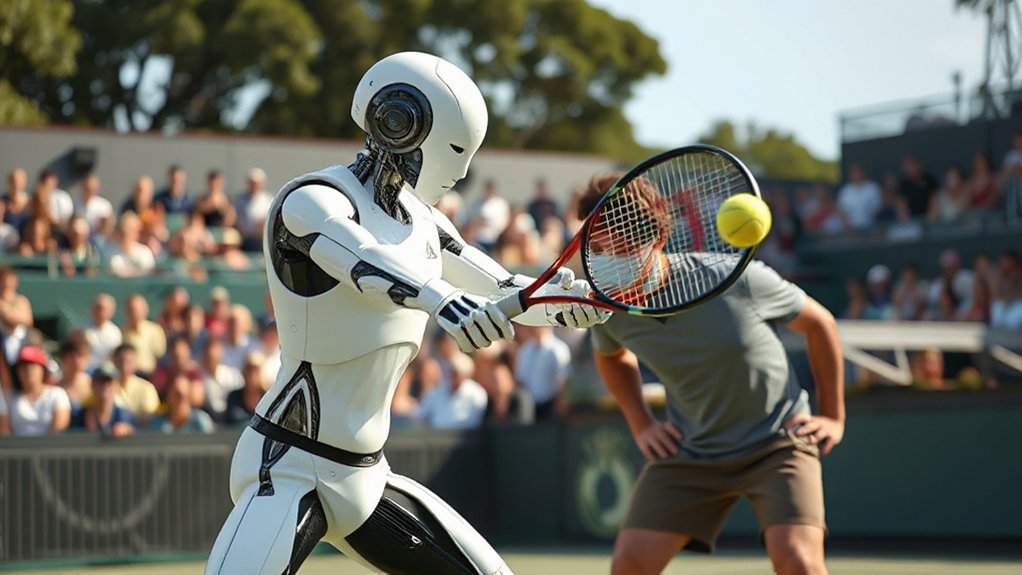
Although robots have been performing tasks in factories for decades, a Beijing-based company called Galbot recently claimed its humanoid robot did something far more athletic. At the Second World Humanoid Robot Games in Beijing, the company said its robot completed more than 100 consecutive tennis rallies against Zheng Jie, a former world No. 15 and Wimbledon semi-finalist. The event was broadcast globally and described as a world first for autonomous humanoid tennis.
Galbot said the robot played without teleoperation, meaning no human was controlling it remotely. The company described the rallies as fully autonomous with no scripted sequence. However, these claims came from Galbot’s own announcement. No independent audit or peer-reviewed study confirmed the rally count, the level of autonomy, or the match conditions. The demonstration was a public showcase, not a controlled scientific test.
Galbot’s autonomy claims remain unverified — no independent audit has confirmed the rally count or match conditions.
Tennis is an extremely demanding sport for a robot. It requires tracking a fast-moving ball, maintaining balance, coordinating footwork, and timing arm swings precisely. The ball’s spin, speed, and placement change constantly. Doing all of this in real time makes tennis one of the hardest challenges in embodied AI. That’s why the claim of 100-plus rallies attracted so much attention, especially against an opponent with elite professional experience. State media reported that serves during the demonstration exceeded 100 kilometers per hour.
Zheng Jie reached the Wimbledon semifinals in 2008 and retired from professional tennis about a decade ago. Her involvement gave the demonstration added credibility in the public eye. Still, the specifics of how hard she was hitting or how she adjusted her play weren’t detailed in available reports.
Galbot’s demonstration isn’t happening in isolation. Recent research has pushed humanoid tennis forward. A system called LATENT achieved a 96.5% success rate in multi-shot rallies during real-world tests. Another framework called AdaPT learned professional tennis styles from broadcast videos and was deployed on real humanoid hardware. These projects show the field is moving from simple demos toward systematic skill learning.
The Galbot event marks a visible milestone in humanoid robotics. Whether the claims hold up under independent review will determine how significant it truly is. For now, it’s captured global attention. The demonstration also included doubles competitions where the robots adapted strategies in real time while partnering with human players.
References
- https://thenextweb.com/news/galbot-autonomous-tennis-robot-100-rallies-claim
- https://www.prnewswire.com/news-releases/worlds-first-autonomous-humanoid-tennis-match-galbot-robots-complete-100-consecutive-rallies-302857810.html
- https://ground.news/article/galbot-robots-complete-100-consecutive-rallies-against-a-tennis-champion
- https://www.unite.ai/de/galbot-robots-complete-100-consecutive-autonomous-tennis-rallies/
- https://werindia.com/science-and-technology/hardware
- https://finance.yahoo.com/technology/ai/articles/two-days-releasing-hiphi-noitom-155600284.html
- https://techxplore.com/news/2026-03-humanoid-robot-tennis-skills-imperfect.html
- https://www.conwaydailysun.com/online_features/press_releases/worlds-first-autonomous-humanoid-tennis-match-galbot-robots-complete-100-consecutive-rallies/article_51930ac7-8be0-58b1-af1a-0777dd5508ae.html
- https://arxiv.org/html/2608.20087v1
- https://www.youtube.com/watch?v=opTdDpE65t4