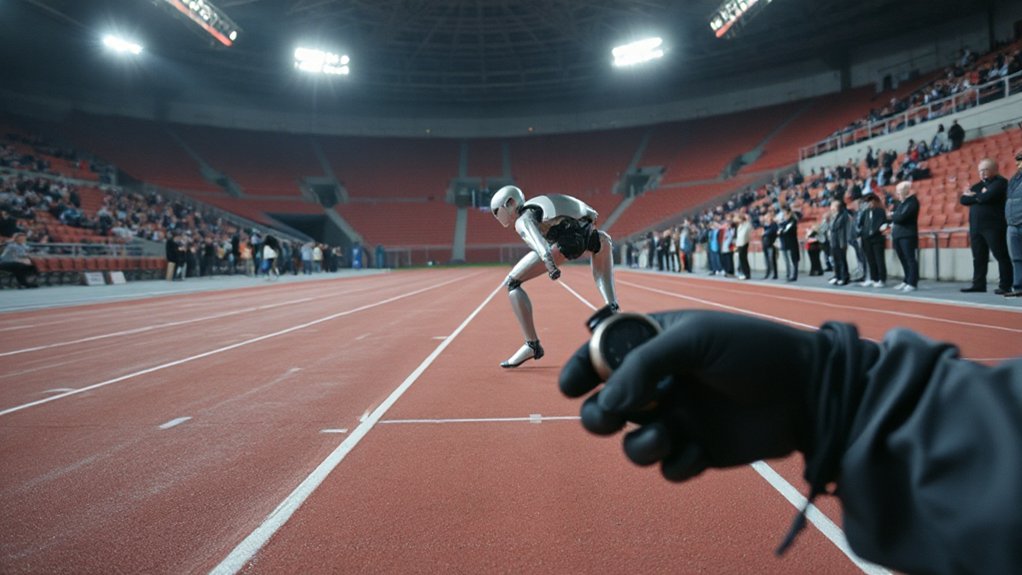
A humanoid robot has outpaced Usain Bolt‘s 100-meter world record — at least on paper. At the World Humanoid Robot Games in Beijing, a robot named Tiangong Ultra reportedly ran 100 meters in 9.39 seconds. A separate robot called Lightning completed the same distance in 9.32 seconds during a practice run. Bolt’s official world record of 9.58 seconds has stood since 2009.
The numbers sound impressive. The faster robot beat Bolt’s time by 0.26 seconds. The slower one still beat it by 0.19 seconds. But robotics experts aren’t celebrating. They say the headline times don’t tell the full story.
Raw speed doesn’t equal real progress — and robotics experts know the difference between a fast time and a true breakthrough.
For starters, these weren’t standard athletics events. Bolt’s record was set under strict rules at an official competition. The robot times came from a robotics contest with different conditions and fewer constraints. One report said Lightning’s faster time came from a practice race, not the main event. Another noted the robot’s speed claims relied on peak speed estimates rather than a verified start-to-finish run. Bolt’s record was achieved during the World Athletics Championships in Berlin.
There were also problems with stability. One account described a robot veering off course and crashing into an electrical box at high speed. That’s a far cry from the controlled, lane-perfect sprinting seen in human track events.
Rodney Brooks, a well-known roboticist, called an earlier Beijing robot race a “publicity stunt.” He said it showed “no safety at all.” Other experts pointed out that running fast on a known track is much easier than doing everyday tasks. A robot that can sprint still can’t fold laundry or safely move around people.
That’s the core issue. Speed on a flat track doesn’t prove a robot can handle balance, obstacles, or real-world environments. Dexterity, adaptability, and robustness matter far more for practical use.
None of this erases the engineering achievement. Building a two-legged machine that moves this fast is genuinely hard. It shows real progress in humanoid robotics. But media coverage framed the result as a milestone for robots, not a replacement for Bolt’s record. Lightning was developed by Chinese smartphone maker Honor, highlighting how tech companies outside traditional robotics are driving these advances. This trend mirrors the broader surge in AI investment, with 92% of companies planning to increase their technology investments over the next three years.
Bolt’s 9.58 seconds still stands in the record books. The robots ran fast, but they ran in a different race entirely.
References
- https://www.bbc.com/news/videos/cgljl9zp47xo
- https://www.youtube.com/watch?v=FGBLzMESBAo
- https://www.dw.com/en/chinese-robot-beats-usain-bolts-100m-world-record/a-78468749
- https://www.aljazeera.com/sports/2026/8/22/usain-bolts-100m-record-broken-at-world-humanoid-robot-games
- https://www.aljazeera.com/video/newsfeed/2026/8/23/chinese-robot-beats-usain-bolts-100m-world-record-at-humanoid-games
- https://www.youtube.com/watch?v=Zbkqhor3EKI
- https://www.youtube.com/watch?v=PzMqoBEbx84
- https://www.bloomberg.com/news/articles/2026-08-23/humanoid-robot-beats-usain-bolt-s-100m-world-record-in-beijing
- https://www.foxnews.com/tech/chinese-humanoid-robot-breaks-usain-bolt-100m-dash-record-9-39-seconds
- https://www.yahoo.com/news/science/articles/humanoid-robot-beats-usain-bolt-161146441.html