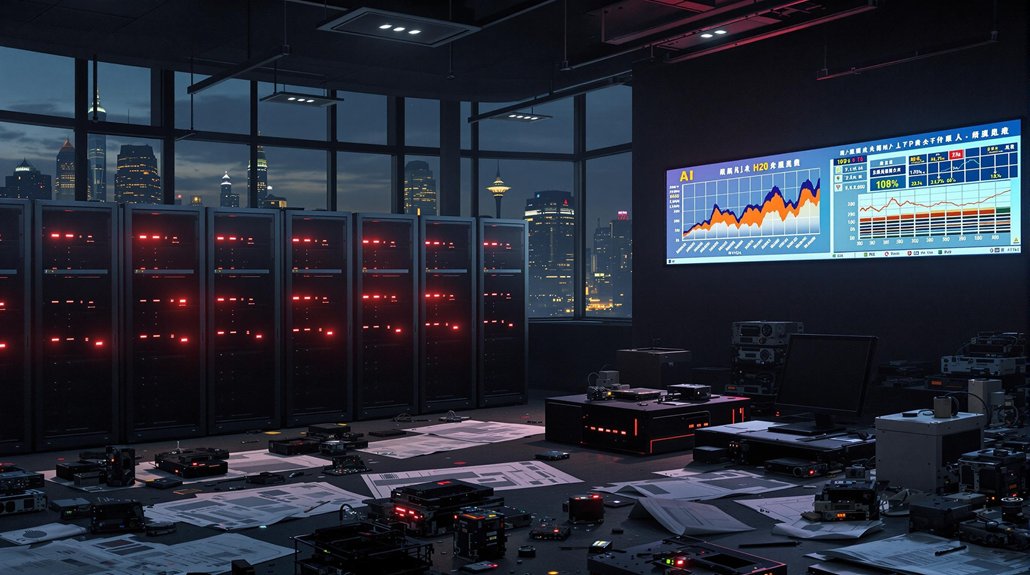

China’s AI development faces a critical challenge as Nvidia H20 chips are nearly depleted in the market. H3C reports new shipments won’t arrive until mid-2025, forcing companies to adapt with cost-saving strategies. Despite impressive growth in China’s AI sector, U.S. export controls have limited access to advanced chips. Chinese firms like 01.AI are responding with innovative approaches, training models at a fraction of competitors’ costs. The technology standoff continues to reshape global AI competition.
Despite once leading the world in AI research papers and patents, China’s artificial intelligence sector now faces severe challenges. The country’s ambitious AI strategy, revealed in 2017, aimed to make China the world’s leading AI innovation hub by 2030. But this goal is now threatened by a critical shortage of advanced computing hardware.
China’s AI dominance falters as hardware shortages derail its 2030 aspirations for global leadership.
H3C, a major Chinese tech company, has warned that Nvidia H20 chips are nearly out of stock. These processors are the most advanced AI chips legally available in China. New shipments aren’t expected until mid-April 2025, creating a significant gap in computing resources.
The H20 shortage comes at a time when China’s AI industry was showing impressive growth. The core AI sector reached a value of RMB 508 billion in 2022, with annual growth exceeding 10% between 2018-2022. Now, companies must find alternative approaches to continue development.
Some Chinese firms have already adapted to resource constraints. 01.AI trained its Yi-Lightning model for just $3 million, compared to the $80-100 million reportedly spent on models like GPT-4. They’ve focused on small, high-quality datasets and clever engineering to overcome hardware limitations. US export controls have significantly impacted China’s AI capabilities by limiting access to leading-edge AI chips. China faces similar integration challenges to those experienced by businesses worldwide, with 90% of organizations struggling to implement AI technologies effectively.
China’s government plays a central role in its AI strategy. The country has implemented strict regulations, requiring AI developers to register their algorithms and adhere to “core socialist values.” These measures are part of 40 policy initiatives under the New Generation AI Development Plan.
On the global stage, China has launched its Global AI Governance Initiative, positioning itself as an alternative to Western approaches. However, limited progress in U.S.-China AI diplomacy has worsened supply chain uncertainties.
The hardware shortage may also impact China’s economy. There are concerns about AI’s effect on employment and the risk of overproduction in various sectors. As China shifts toward AI-driven automation, balancing efficiency gains with economic stability becomes increasingly difficult.
As geopolitical tensions continue, China’s path to becoming the world’s AI leader faces more obstacles than ever before. The sudden surge in demand from tech giants like Alibaba and ByteDance has further exacerbated the H20 chip shortage situation.