
Despite leading with 57% of elite AI researchers, the U.S. faces growing challenges to its AI dominance. China has responded to U.S. chip restrictions by focusing on AI efficiency and aggressive open-source strategies. Chinese companies now offer models competitive with ChatGPT-4 at lower costs while providing unrestricted AI access to developing nations. This shift could reshape global technology standards and military power dynamics. The outcome will determine tomorrow’s technological landscape.
As the global artificial intelligence race intensifies, the United States and China are engaged in a high-stakes competition for AI dominance. The U.S. currently leads with 57% of elite AI researchers compared to China’s 12%, but this advantage faces growing challenges.
America’s AI strength comes from private companies and open-source models, with limited government funding. In contrast, China uses central planning and state money to build national computing centers and develop AI technologies. The U.S. recently started its $500 billion Stargate Project to boost AI infrastructure, showing awareness of this competition.
America’s tech innovation emerges from market forces, while China leverages centralized planning and massive state investment to close the AI gap.
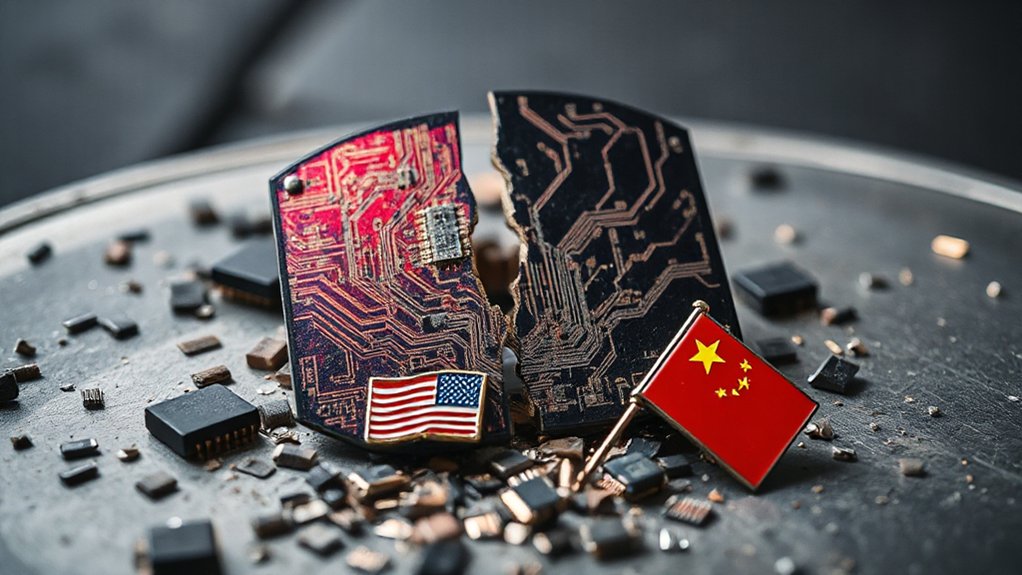
China’s approach is proving effective. DeepSeek’s R1 model now rivals ChatGPT-4 at lower costs. China focuses on efficiency to overcome U.S. chip export restrictions, which limit access to advanced technology. These export controls, meant to protect U.S. interests, may actually speed up China’s AI development by forcing domestic innovation.
Chinese firms now offer unrestricted AI access to developing nations while U.S. companies face regulatory barriers. China’s aggressive embrace of open-source AI creates a stark contrast with America’s predominantly closed systems, allowing for faster innovation and wider adoption across global markets. This creates opportunities for China to expand influence in emerging markets. With AI projected to contribute over $15.7 trillion to the global economy by 2030, China’s strategic positioning could yield significant economic advantages. China plans to invest $1.4 trillion in technology by 2030, strengthening its global position in AI development and deployment.
The military implications are significant. China’s military-civil fusion policy integrates AI advances into defense systems, raising security concerns for the U.S. The integration of civilian AI innovations enables rapid development of autonomous weapons systems that could potentially shift the balance of military power. As Chinese AI capabilities grow, America’s technological advantage may shrink, affecting global power dynamics.
Economic impacts are already visible. U.S. chip restrictions have boosted China’s domestic semiconductor industry. Stock markets react strongly to Chinese AI breakthroughs, showing the financial importance of this technology race.
If current trends continue, China could leverage its AI advances to reshape global technology standards and economic relationships. The U.S. faces a critical challenge: balancing necessary security restrictions while avoiding policies that inadvertently accelerate China’s path to AI leadership and global influence.