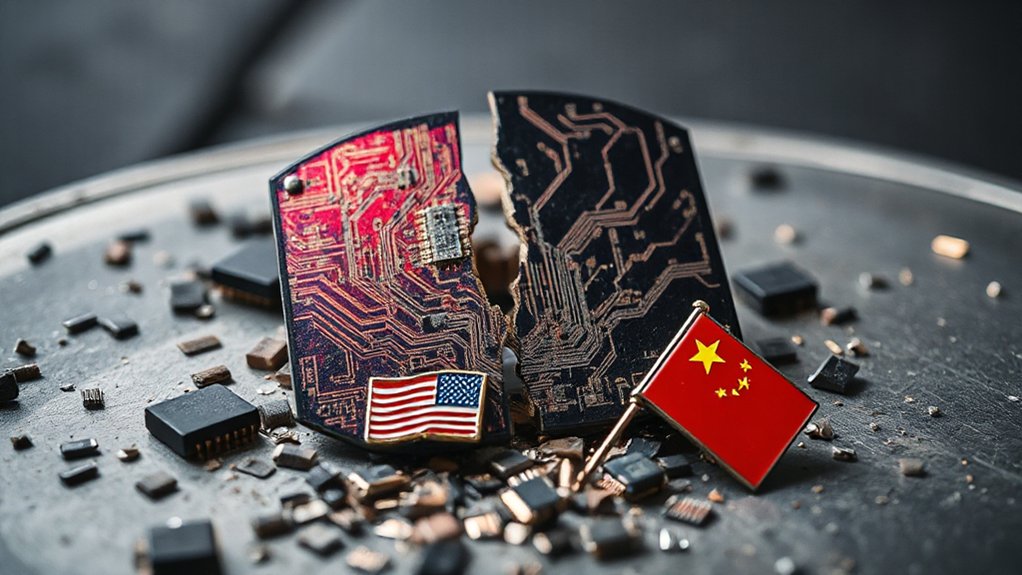

The global chip war‘s heating up. The US, China, and Europe are all feeling the pressure. And it’s affecting everything from AI to car manufacturing.
Nvidia just revealed its Blackwell platform. It features the GB200 Grace Blackwell Superchip. This new chip delivers 30 times better performance for AI tasks. It can handle models with trillions of parameters. It also includes fifth-generation NVLink technology. Nvidia’s clearly pushing hard to stay on top.
Nvidia’s Blackwell platform is here — and it’s rewriting the rules of AI performance.
But Nvidia’s got competition. Qualcomm announced its AI200 and AI250 chips for data centers. These chips focus on using less power while cutting costs. Qualcomm’s challenging Nvidia’s dominance in AI hardware. It’s also pushing to make AI more accessible to more people.
Meanwhile, the US government’s making bold moves. The Trump administration’s investing heavily in Intel. It’s forcing Intel to build factories in the US to hire American workers. The goal’s to keep China away from American chip technology. It’s part of a bigger plan to protect US dominance in semiconductors.
The US also approved limited H200 chip sales to China. But there’s a 25% surcharge on every transaction. There are also strict limits on how many chips China can buy. It’s a careful balance between restricting China and allowing some trade.
China isn’t staying quiet, though. It’s escalating its response to US restrictions. China’s pushing hard to build its own chips domestically. These moves are creating serious tensions in global supply chains. Chinese tech giants like ByteDance, Alibaba, and Tencent have collectively ordered $16 billion in chips to stockpile AI hardware before potential future bans take effect.
Those tensions are hitting Europe hard. EU carmakers are reportedly days away from halting production lines. The reason’s a computer chip supply crisis tied to China. Industry leaders are warning of immediate work stoppages. Beijing’s ban on Nexperia chip supplies has further strained the situation, as the European chipmaker’s products are packaged in China before global distribution.
It’s a stark reminder of how dependent global manufacturing’s become on chips.
The bigger picture’s concerning. AI hardware innovation’s accelerating fast. US policy’s shifting toward domestic manufacturing. Conditional chip exports are changing trade relationships. Blackwell’s 208 billion transistors are fabricated on TSMC’s custom 4NP process, underscoring how advanced chip manufacturing has become a critical geopolitical asset.
And supply chain disruptions could ripple worldwide. The chip war isn’t just about technology anymore. It’s about economic power, jobs, and global stability.
References
- https://www.financialcontent.com/article/tokenring-2025-11-7-ai-chip-wars-escalate-nvidias-blackwell-unleashes-trillion-parameter-power-as-qualcomm-enters-the-data-center-fray
- https://www.rivianforums.com/forum/threads/eu-carmakers-‘days-away’-from-halting-work-as-chip-war-with-china-escalates.52203/
- https://www.binance.com/en/square/post/28350335806066
- https://c.poorc.com/t/topic/1223
- https://www.youtube.com/watch?v=bZ5hrpJA02E