
Disney’s WALL-E robot brings the beloved Pixar character to life with remarkably emotive capabilities. The robot features distinctive binocular eyes and fully articulated arms that allow it to mirror human movements and express emotions effectively. With over 310 parts including 210 tank tread components, this sophisticated droid responds to voice commands, follows objects, and maintains balance while moving. This innovative fusion of AI and animation techniques represents just the beginning of entertainment robotics‘ exciting future.
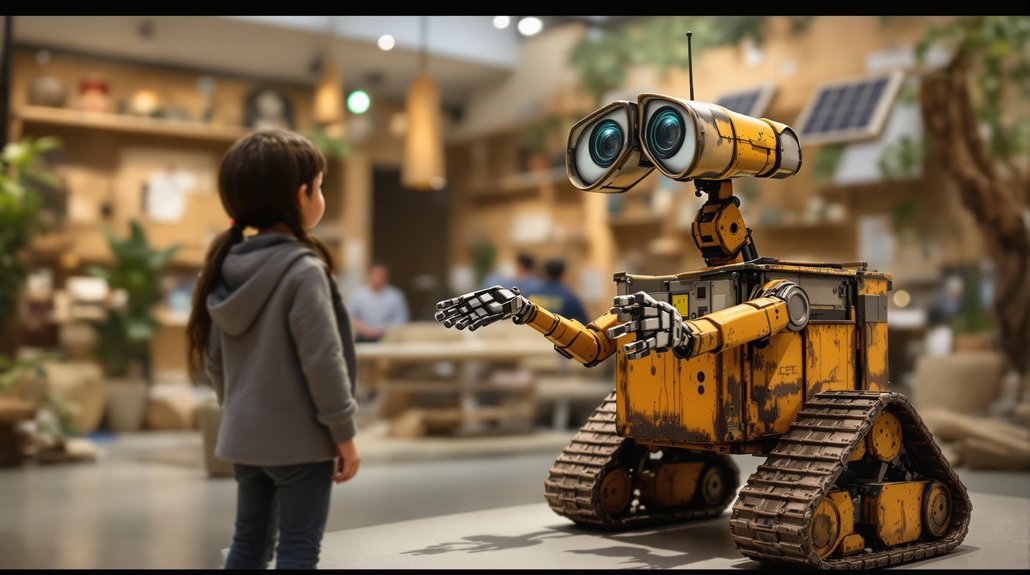
The iconic WALL-E robot, inspired by the beloved Pixar character, has made the leap from animation to reality through advanced robotics technology. Disney’s engineers have successfully translated the animated character’s charm into a functioning robot that mirrors human movements. The robot features distinctive binocular-shaped eyes that can convey emotions effectively, just like its animated counterpart.
This technological marvel incorporates over 310 parts, including 210 small tank tread components that provide stable ground navigation. The robot’s arms, neck, and hands are fully articulated, allowing for expressive movements that capture WALL-E’s endearing personality. Servo motors independently control the head and eye motions, creating lifelike responses to human interaction. The finishing process involves applying weathering techniques using black and brown acrylic paints to enhance the robot’s authentic worn appearance.
Disney Research has focused on creating robots with emotive physical behaviors, showcasing their work at major robotics conferences. The translation from animation to robotics required close collaboration between animators and engineers to guarantee the robot maintained WALL-E’s personality-filled gaits and traits. This partnership has resulted in a robot that can perform expressive movements, including gestures and dancing. The robot’s embodied AI capabilities enable more dynamic interactions with its physical surroundings, similar to research advances in the field.
The WALL-E robot includes voice recognition systems that allow it to respond to programmed commands. It can follow objects, balance itself, and adapt to different environments, mimicking human-like behavior. The robot employs sophisticated bipedal locomotion systems that enable it to walk on two legs while maintaining stability. Users can control the robot via PCs or external devices, enhancing its operational flexibility.
3D printing technology has made the manufacturing process more accessible, reducing costs and enabling rapid prototyping. The modular design features easy-to-assemble parts that can be customized with options like camera integration in the eyes and unique joint configurations.
The complete assembly process takes approximately three months, depending on skill level and part availability. Disney’s integration of AI, animation techniques, and robotics has created a WALL-E robot that doesn’t just look like the character from the movie—it moves and interacts like him too, bringing the beloved droid to life in ways that delight fans and showcase the future of entertainment robotics.