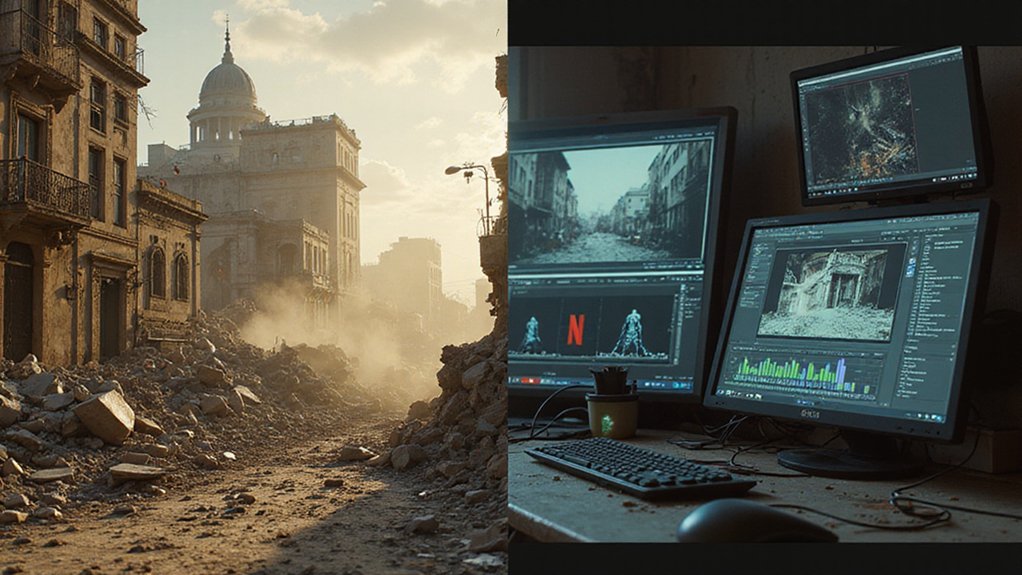
In a surprising move during its Q2 2025 earnings call, Netflix revealed that generative AI was used to create the major building collapse scene in its recent series “The Eternaut.” The streaming giant’s co-CEO Ted Sarandos casually dropped this bombshell months after the show’s April premiere. Talk about burying the lede.
This marks the first confirmed use of generative AI for visual effects in a Netflix original. Not just an enhancement tool – full-on prompt-based generation, like asking DALL-E to destroy a fictional Buenos Aires. And guess what? Nobody noticed. Viewers had no clue they were watching AI-generated devastation.
The tech choice wasn’t random. Traditional VFX for the collapse scene would’ve blown the budget. AI knocked it out 10 times faster than conventional methods. Practical decision. Money saved. Schedule maintained. Sarandos framed it as a creative solution, not worker replacement – though unions might have questions.
The workflow was straightforward: text prompts from creative teams, AI generates visuals, compositors blend with live-action footage. Seamless integration. Critics and audiences praised the scene’s authenticity without knowing its digital origins. The production involved Eyeline Studios and Argentine creatives working collaboratively on the sequence to maintain local authenticity.
Netflix’s approach could reshape how smaller productions handle big VFX moments. Can’t afford a traditional effects team for that one essential explosion? AI’s got you covered. The company insists this augments creative teams rather than replaces them. Sure, for now.
Media coverage has highlighted Netflix’s transparency as an industry milestone. Though “transparency” feels generous when the revelation came months after release. Still, the quality speaks for itself – the scene convincingly portrays destruction in a 1950s Argentine sci-fi adaptation that premiered on April 30, 2025.
The implications stretch beyond just one show. As AI becomes more integrated into visual storytelling, the line between traditional and AI-assisted production blurs. Efficiency, budget control, creative possibility – all compelling advantages. With AI technology contributing to economic gains of $4.60 for every dollar invested, studios have strong financial incentives to adopt these tools.
The question isn’t if more studios will follow Netflix’s lead, but when. The future of VFX might already be here, hiding in plain sight.