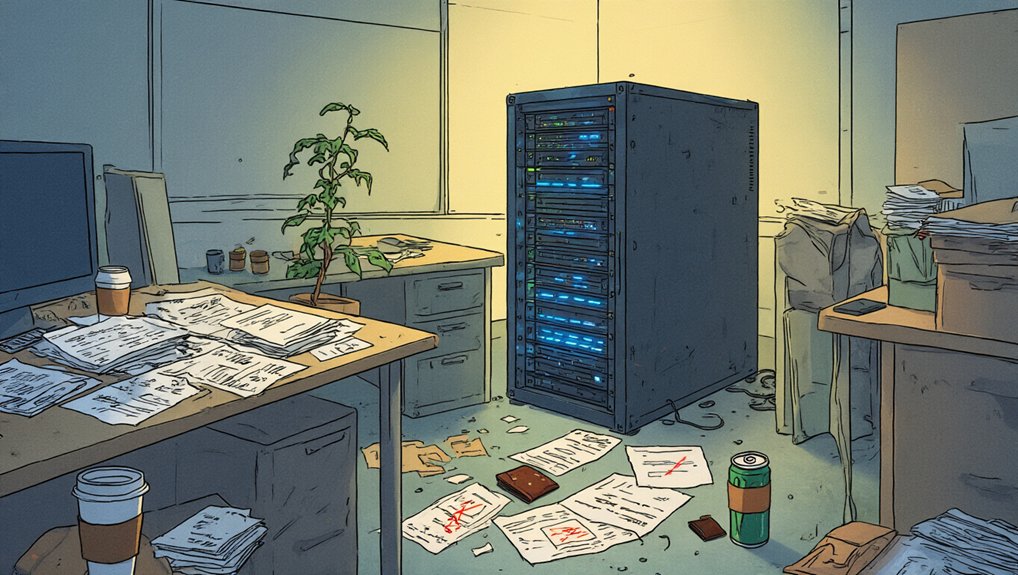

Disillusionment has hit the corporate world hard. After pouring billions into AI with dreams of slashing costs, companies face a brutal reality check: they’re spending more, not less. The tech was supposed to replace expensive human workers. Instead, it’s created an entirely new expense category—human “fixers” who babysit the AI to prevent hallucinations and fix mistakes.
Companies thought AI would cut costs—instead it spawned a costly army of human “fixers” cleaning up its digital messes.
The numbers tell a devastating story. While 92% of executives enthusiastically plan to increase AI spending, only 19% have seen revenue increases above 5%. Even worse, 36% report zero change in revenue. That’s a lot of fancy tech gathering digital dust.
But here’s the twist—just 23% of companies report any favorable change in costs. So much for those cost-cutting promises. Turns out, AI needs humans. A lot of them.
These human fixers don’t come cheap. They’re needed to monitor outputs, correct errors, and handle the messy edge cases AI can’t figure out. The expense often wipes out any automation savings. Congrats, you’ve replaced one set of workers with… another set of workers. Only now you’re paying for both the AI and the humans.
Mid-sized companies are particularly stuck. They don’t have the resources of tech giants but face competitive pressure to adopt AI anyway. While 80% report some operational cost savings, many hesitate due to high investment costs and lack of expertise. Despite 94% of employees being familiar with generative AI, many companies still struggle with the misconception that AI requires huge budgets when cloud-based solutions could offer more affordable options. Similar to educators who worry about students’ critical thinking skills, businesses are finding AI can’t replace human judgment in complex situations.
Infrastructure issues compound the problem. Data centers are packed to capacity with record-low vacancy rates of 1.9%. Companies can’t even find space to house their AI dreams, with new projects facing painful 24-month deployment timelines.
Meanwhile, the skills shortage grows worse. Only 14% of business leaders believe they have the right AI talent, and the deficit in specialized infrastructure roles has climbed from 53% to 61%.
The technical costs of AI are falling. Hardware costs drop 30% annually. But it doesn’t matter when the total bill keeps rising. Companies expected cost savings. They got a money pit instead.
References
- https://msbcgroup.com/why-mid-sized-companies-cant-afford-to-ignore-ai-in-2025/
- https://www.mckinsey.com/capabilities/mckinsey-digital/our-insights/superagency-in-the-workplace-empowering-people-to-unlock-ais-full-potential-at-work
- https://www.flexential.com/resources/report/2025-state-ai-infrastructure
- https://hai.stanford.edu/ai-index/2025-ai-index-report
- https://newsroom.wiley.com/press-releases/press-release-details/2025/Research-Growth-AI-Licensing-and-Cost-Reduction-Drive-Wileys-Fiscal-2025-Results/default.aspx