While farmers have spent millennia perfecting their craft with hand tools and tractors, the future of agriculture is decidedly less human. The robots are coming—actually, they’re already here. With the global autonomous farm equipment market ballooning to $76.54 billion in 2025 and projected to hit $128.42 billion by 2034, traditional farmhands might want to update their resumes.
North America leads this agricultural transformation, with the U.S. market alone expected to exceed $46.63 billion by 2034. Why? Because robots don’t complain, take breaks, or demand raises. They just work. And governments are throwing money at the shift through subsidies and R&D investments, fundamentally paying farms to replace people with machines. Industry giants like John Deere are revolutionizing farming with autonomous tractors that can operate without a driver.
Robots don’t strike, sleep, or ask for benefits—they just make American agriculture ruthlessly efficient.
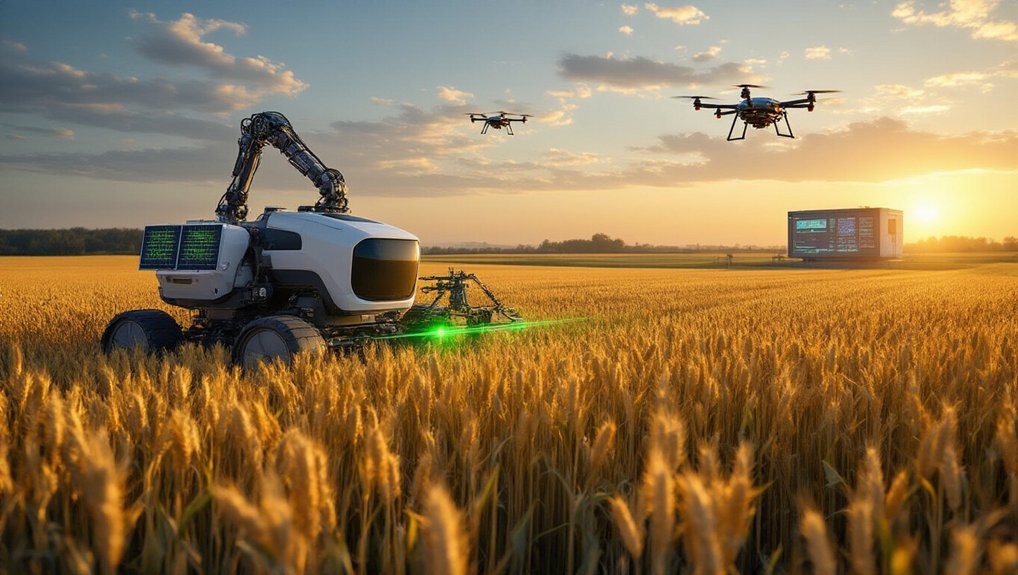
These aren’t your grandpa’s tractors. We’re talking AI-driven machinery that can plant, water, and harvest with precision that makes human farmers look like bumbling amateurs. Self-driving tractors navigate fields with GPS. Drones and satellites monitor crops from above. Over 60% of American farms are expected to adopt precision agriculture technologies by 2025. Robots eliminate weeds without chemicals. Even the cows are being watched by algorithms now.
The human cost? Farm automation is projected to slash manual labor needs by up to 40%. Sure, there’ll be jobs for tech whizzes who can program and fix these mechanical farmhands, but seasonal workers and traditional farm laborers? Not so much. Similar to healthcare’s AI transformation, these systems use machine learning to identify patterns and predict optimal growing conditions.
The economics are brutal but compelling. Automated systems deliver up to $12 billion in annual efficiency gains in the U.S. by 2025. Vertical farms using robots can boost yields by 70% compared to traditional methods. The machines work 24/7, don’t need sleep, and never call in sick.
There’s an environmental silver lining, at least. Farm bots apply chemicals with surgical precision, reducing overall usage. They monitor soil health obsessively and waste fewer resources.
The future farm looks like a tech company that happens to grow food. Less mud on boots, more code on screens. Less human touch, more algorithmic precision. Progress? Perhaps. Inevitable? Absolutely.
References
- https://farmonaut.com/usa/farming-in-america-2025-powerful-trends-shaping-agriculture
- https://www.omv.com/downloads/2025/04/9002ad47-c099-57cb-1786-9c8f2fa7f4d2/z Group Directors Report 2024.pdf
- https://www.precedenceresearch.com/autonomous-farm-equipment-market
- https://humanresearchroadmap.nasa.gov/evidence/reports/Risk of Inadequate Human-System Integration Architecture approved.pdf
- https://farmonaut.com/precision-farming/vertical-farming-automation-7-game-changing-trends-for-2025