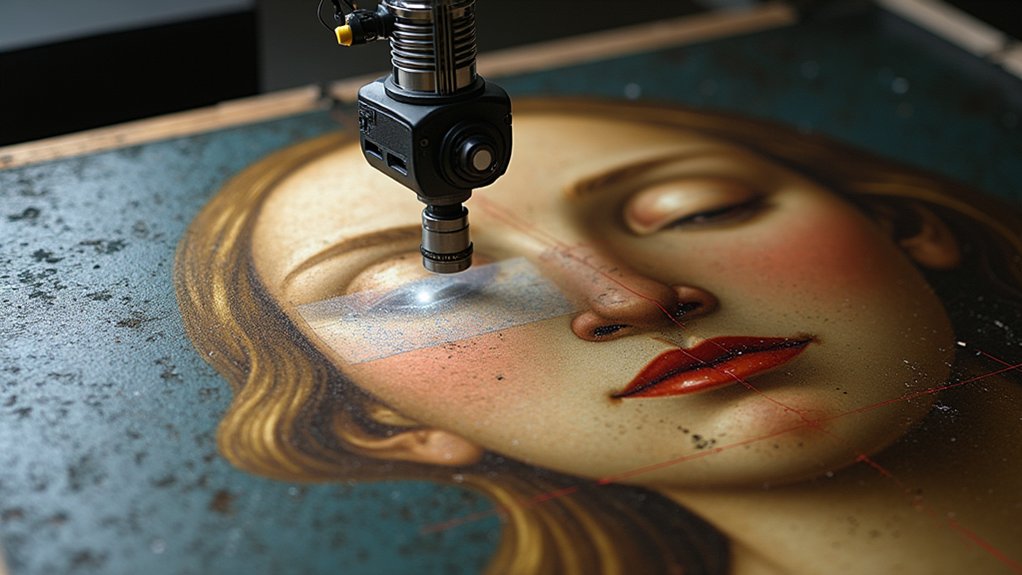

While art conservators used to spend months hunched over damaged masterpieces with tiny brushes, AI now does the job in hours. That’s right. Hours. Not weeks. Not months. Just hours.
The secret sauce? Computer vision and image recognition that would make your smartphone camera jealous. These AI systems scan damaged paintings, analyze every crack and faded brushstroke, then generate polymer masks that fit like a glove. Print them out, slap them on, and boom – instant restoration. Well, almost instant.
Here’s where it gets wild. These thin polymer films align perfectly with the original artwork. No guesswork. No artistic interpretation. Just pure, data-driven precision that matches colors and textures better than human eyes ever could. And the best part? They peel right off. No damage. No permanent changes. It’s like Photoshop for real paintings.
Museums are having a field day with this tech. They’re churning through restoration backlogs that would’ve taken decades to clear. More art gets fixed, more people see it, everyone’s happy. Scholars get their hands on previously damaged works. Digital twins pop up in online archives. Even broke institutions can suddenly afford to save their collections.
But hold up. This isn’t magic. AI still chokes on severely damaged pieces. Those printed films need to match perfectly, or they stick out like a sore thumb. And good luck reproducing the exact way a 500-year-old pigment aged. Some old-school conservators are clutching their pearls, worried robots will replace human judgment entirely. Much like how AI reduced protein structure prediction time from years to days, restoration technologies are compressing timelines in unprecedented ways across creative fields, enabling paradigm shifts in heritage conservation.
They shouldn’t panic. Humans still run the show. Every AI suggestion gets vetted by experts who know their Rembrandts from their Renoirs. The machines learn from human-curated datasets, not random internet junk. It’s a partnership, not a takeover. AI functions as a supportive tool that enhances human expertise rather than replacing the nuanced understanding conservators bring to their craft.
The tech keeps improving. Researchers are figuring out how to handle tougher cases and guarantee these polymer films won’t fall apart in fifty years. Virtual simulations let conservators test different approaches without touching the actual artwork. Alex Kachkine at MIT developed this innovative approach that merges digital analysis with traditional conservation wisdom, publishing breakthrough research in Nature.
This transformation isn’t just about speed. It’s about saving art that might otherwise rot away in storage. Pretty cool for a bunch of algorithms and plastic sheets.
References
- https://www.nyu.edu/about/news-publications/news/2025/april/the-human-gaze-meets-the-machine-gaze-as-nyu-s-institute-of-fine.html
- https://bioengineer.org/restore-your-damaged-paintings-in-hours-with-ai-generated-masks/
- https://theoutpost.ai/news-story/ai-generated-mask-revolutionizes-art-restoration-mit-researcher-develops-groundbreaking-technique-16515/
- https://profiletree.com/ai-in-art-restoration-conservation/
- https://www.eurekalert.org/news-releases/1086741