While farmers have been tilling soil for thousands of years, AI is now telling them exactly where to put their seeds. The global AI agriculture market hit $4.7 billion in 2024 and shows no signs of slowing down. That’s a 26.3% growth rate that would make any Wall Street banker jealous.
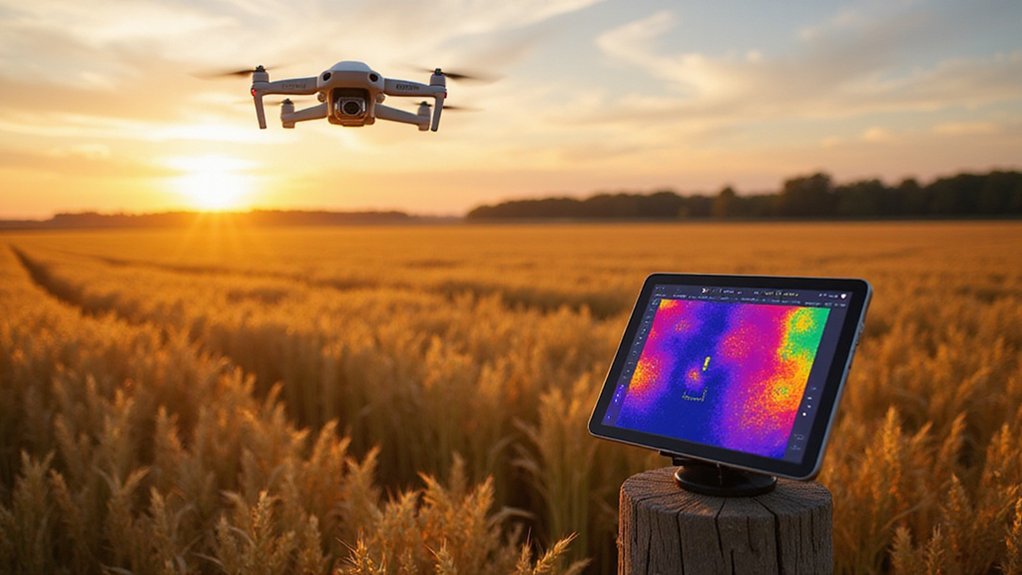
The technology sounds like science fiction, but it’s happening right now in cornfields across America. AI platforms scan satellite images and crunch weather data to spot diseased crops before farmers can see anything wrong. No yellowing leaves. No visible rot. The algorithms just know. Machine learning analyzes massive agricultural datasets with 50% market dominance, powering everything from pest predictions to harvest forecasting.
AI spots crop diseases before farmers see anything wrong—the algorithms just know.
It’s unsettling for farmers who’ve trusted their gut instincts for generations. One day you’re checking crops the way your grandfather did, squinting at the horizon. The next day, some computer program is telling you there’s fungus brewing in section 4B before you’ve had your morning coffee. The machine doesn’t care about your decades of experience.
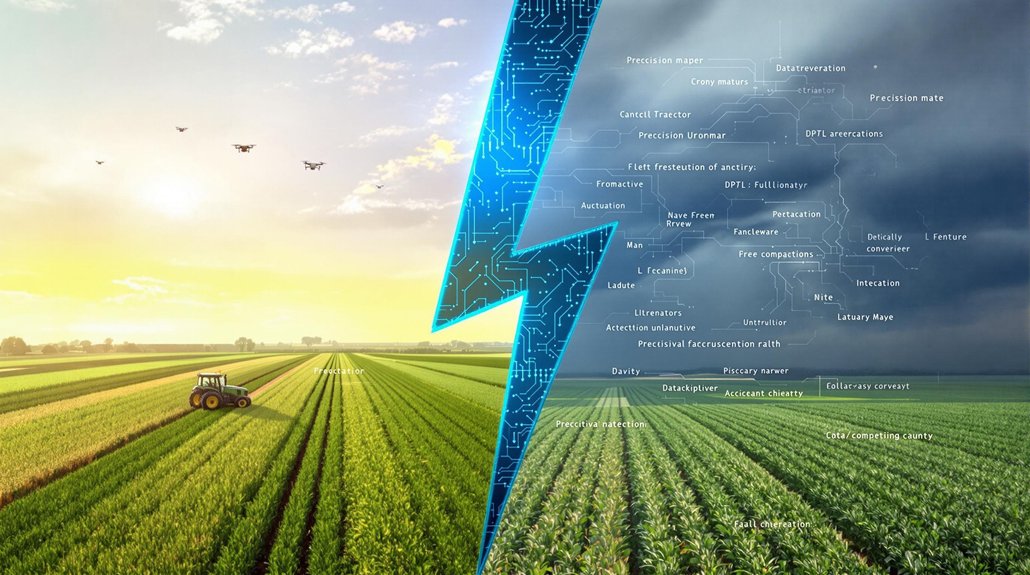
These predictive analytics forecast everything from pest invasions to exact harvest yields. Precision prescription mapping—yes, that’s actually what they call it—tells farmers to spray fertilizer here but not there, down to the square foot. The combination of regenerative farming practices with AI-driven precision can boost farm profits by up to 120 percent. The old spray-and-pray method? Dead as disco.
Autonomous tractors now roll through fields without drivers. Harvest robots pick strawberries with mechanical fingers that never get tired. Drones buzz overhead, scanning millions of acres in hours. Much like wind turbines that have doubled in capacity since 2007, these agricultural technologies are becoming increasingly efficient and powerful. The machines work 24/7 and don’t complain about overtime. Meanwhile, rural workforces keep shrinking as young people flee to cities.
The financial numbers make resistance futile. Early AI adopters report higher yields, fatter margins, and dramatically reduced chemical use. Big data platforms serve up recommendations on smartphones while farmers sit in their pickups. Cloud-based dashboards track everything from soil moisture to market prices in real-time.
Traditional farming is becoming digital precision agriculture whether old-timers like it or not. As food demand explodes and farmland shrinks, the choice gets simpler: adapt or get buried. The AI transformation isn’t coming to agriculture. It’s already here, predicting crop diseases and changing everything.
References
- https://www.gminsights.com/industry-analysis/ai-in-agriculture-market
- https://www.weforum.org/stories/2025/01/delivering-regenerative-agriculture-through-digitalization-and-ai/
- https://www.oldnational.com/resources/insights/disrupting-agriculture-how-ai-and-data-are-powering-the-2025-agtech-revolution/
- https://www.precisionfarmingdealer.com/articles/6440-how-ai-is-transforming-modern-agriculture-in-2025
- https://thrakika.gr/post/ai-in-agriculture-expected-to-grow-exponentially-by-2025-report-states-V7