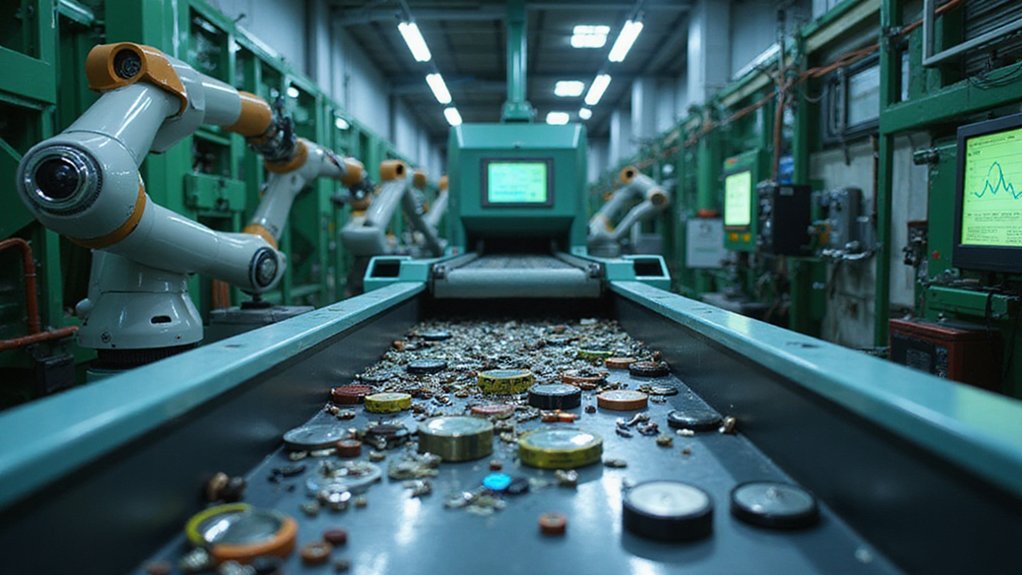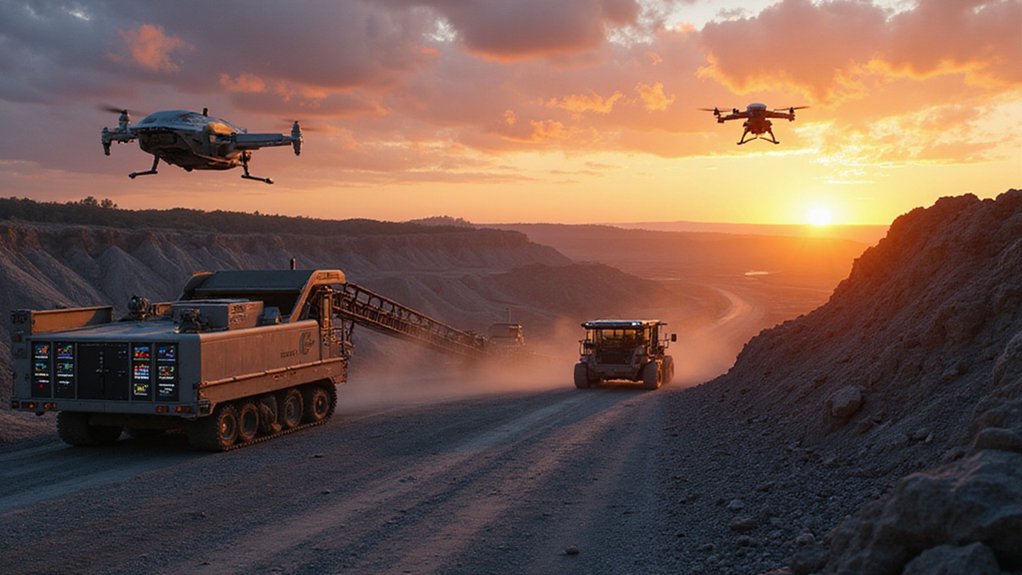
Rebellion isn’t too strong a word for what’s happening in America’s mines. Traditional pickaxes and gut instinct are out. Artificial intelligence is in. And it’s changing everything.
The numbers tell the story. AI in mining is expected to hit $7.2 billion by 2033, growing at a blistering 22.7% annually. That’s not pocket change. That’s a seismic shift in how Americans dig stuff out of the ground.
BHP didn’t get the memo about waiting around. They partnered with Microsoft last year to juice up copper recovery at Chile’s Escondida mine. Their AI analyzes plant data, tells operators exactly how to tweak their systems, and boom – better ore processing, better grades. Simple as that.
But here’s where it gets interesting. The Department of Energy’s AI tech just found a record-breaking rare earth deposit right here in the U.S. Not in China. Not in Australia. Here. The same technology that helps you find the nearest Starbucks is now finding critical minerals buried deep underground.
BHP’s on a roll, using AI to discover new copper deposits in Australia and the United States. Goldcorp – now part of Newmont – built an AI model with IBM Canada that predicts where gold might be hiding. It’s like having X-ray vision, except it actually works.
The government’s getting in on the action too. AI coupled with remote sensing helps them spot illegal mining operations fast. Advanced algorithms detect illegal deforestation by analyzing topographical changes. Big Brother meets Mother Earth, and for once, it might actually help.
Strategic partnerships are popping up everywhere. BHP and Ivanhoe Electric joined forces in May 2024, combining geophysical transmitters with machine learning to hunt for copper, nickel, gold, and silver. The USGS partnered with DARPA to accelerate critical mineral assessments across America. AI-powered site inspections using drones now account for over 29% of AI applications in mining, revolutionizing how companies monitor vast operations. Yet every AI-powered discovery comes with a hidden cost – communities near mining sites face water contamination from open pit operations and chemical leeching. Despite claims of improved accuracy, companies must invest significant resources to fact-check AI outputs due to hallucination rates that can reach up to 27% in generated content.
Here’s the kicker: six new large copper mines need to open every year just to feed the growing appetite of AI and other technologies. The machines that find the minerals need the minerals to exist. It’s almost poetic. Almost.
References
- https://vjel.vermontlaw.edu/top-ten/2025-top-ten/2024/12/ai-is-mining-more-than-data/
- https://www.energy.gov/technologycommercialization/articles/ai-tool-speeds-critical-mineral-hunt-boosting-us-supply
- https://www.usgs.gov/centers/gggsc/science/21st-century-prospecting-ai-assisted-surveying-critical-mineral-potential
- https://market.us/report/ai-in-mining-market/
- https://www.spglobal.com/market-intelligence/en/news-insights/research/a-peek-at-ai-revolution-in-mining-promise-meets-peril