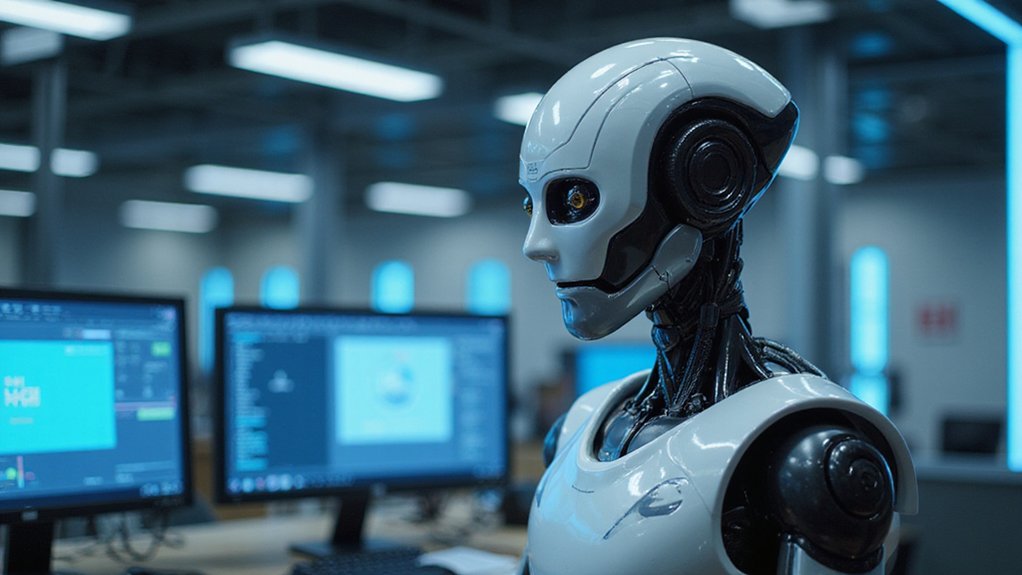

A marvel of modern engineering, Boston Dynamics‘ fifth-generation Atlas robot represents a considerable leap forward in humanoid robotics. Standing T meters tall and weighing 89 kilograms, this fully electric robot has replaced the previous hydraulic system that powered earlier models.
Atlas can move at impressive speeds of up to 2.5 meters per second. It features 28 degrees of flexibility, giving it enhanced mobility and dexterity that rivals human movement capabilities. The robot’s articulated head includes integrated LED lights that help it navigate and perceive its environment. The robot’s lightweight design incorporates titanium and aluminum 3D printed parts that contribute to its exceptional performance capabilities.
With 28 degrees of flexibility and speeds reaching 2.5 m/s, Atlas’s LED-equipped head and human-like dexterity revolutionize robotic movement.
Boston Dynamics developed Atlas with initial funding from DARPA. The robot has evolved considerably since its first version, culminating in the current electric form released in 2024. This latest model represents decades of research in humanoid robotics and showcases the company’s commitment to creating capable mobile robots.
Atlas uses advanced artificial intelligence for autonomous operation. It’s equipped with LIDAR and stereo vision systems that allow it to navigate complex environments. The connections between its perception and control systems enable Atlas to adapt quickly to changing conditions. Its distinctively designed head was inspired by Pixar lamp and can rotate in ways impossible for humans.
The robot can carry payloads of up to 11 units. It demonstrates dynamic manipulation using both hands and its full range of motion. Atlas can be equipped with various grippers depending on the tasks it needs to perform.
Boston Dynamics designed Atlas specifically for real-world applications. The robot can interact with its environment in meaningful ways through its advanced manipulation capabilities. It has potential for deployment across various sectors where autonomous task performance is needed.
Future plans for Atlas include continuous updates and refinements. Boston Dynamics aims to increase the robot’s speed and energy efficiency. The company also plans to develop more advanced learning algorithms for the robot. The ultimate goal is to make humanoid robots like Atlas more common and useful in everyday tasks.