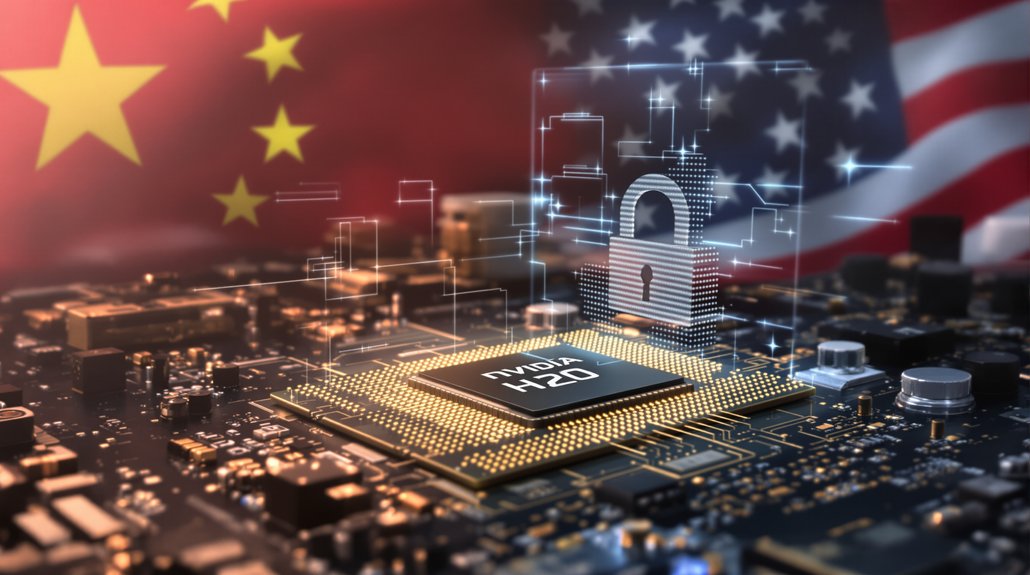

As tensions between the U.S. and China continue to rise, Nvidia has stopped making its H20 artificial intelligence chips after Chinese government agencies warned companies not to buy them. The production freeze affects major suppliers including Foxconn, Samsung Electronics, and Amkor Technology. These companies now have excess inventory piling up in their warehouses.
The H20 was the most advanced Nvidia chip that U.S. export rules allowed in China. But Chinese officials now worry these chips might contain “backdoors” that could let foreign governments spy on China or steal data. The Cyberspace Administration of China and other agencies told companies to get special licenses before importing AI chips. They’re especially concerned about chips used in important sectors.
Chinese officials worry advanced AI chips might contain backdoors for foreign surveillance and data theft.
This situation shows how technology has become a battleground between the two countries. The U.S. limits what advanced chips can be sold to China, fearing they could be used for military purposes. Meanwhile, China wants to protect itself from what it sees as security risks in foreign technology.
Chinese companies that planned to use H20 chips now face delays in building their AI systems. The government is pushing them to buy domestic chips instead. This sudden change has created problems throughout the supply chain. Samsung and Amkor had to stop making special packaging and components for the H20 chips.
Nvidia’s CEO Jensen Huang recently visited TSMC in Taiwan to discuss the production problems and possible solutions. During the visit, Huang revealed that six new chips have been taped out at TSMC, including GPU and silicon photonics processors. The company says its H20 chips were meant only for commercial use, not for military or government systems. Nvidia is now working on new chip designs that might satisfy both U.S. export rules and Chinese concerns. Despite the China-related challenges, analysts are raising price targets for Nvidia as they remove China revenue from their models.
The freeze highlights China’s growing push to develop its own semiconductor industry. Chinese officials want their country to rely less on foreign technology, especially for AI applications. They’re providing more support for local chip makers as part of this strategy.
For now, the production halt leaves both sides dealing with uncertainty. Chinese tech companies struggle to find alternatives while Nvidia and its suppliers face lost revenue and disrupted operations. The situation reflects the broader challenge of maintaining technology partnerships amid growing political tensions.