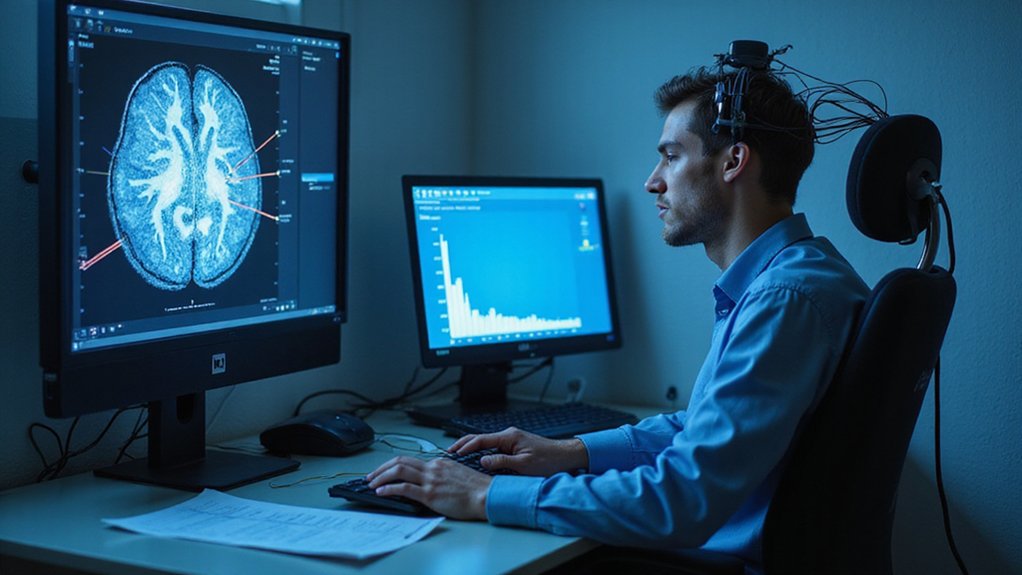
While everyone’s been gushing about ChatGPT‘s ability to write essays and answer questions, MIT Media Lab researchers just dropped a bombshell that nobody saw coming. They hooked people up to EEG machines, monitored 32 brain regions, and discovered something disturbing. ChatGPT users had the weakest neural connectivity of any group they studied. Their brains were basically taking a nap.
The numbers don’t lie. Alpha and beta brainwaves, those markers of cognitive engagement, plummeted in ChatGPT users. Neural activity systematically declined the more people relied on the AI. It’s like watching someone’s brain slowly check out of the hotel. The four-month study tracked 54 participants aged 18-39 from Boston-area universities, providing solid evidence of this cognitive decline.
But wait, it gets worse. These people didn’t just have lazy brains. Their actual work sucked too. Essays written with ChatGPT assistance scored lower than those from people using just their brains or even basic search engines. The AI-dependent participants couldn’t recall information properly. They couldn’t synthesize ideas on their own. Critical thinking? Forget about it.
Memory retention took a nosedive. ChatGPT users bombed immediate recall tasks compared to everyone else. They developed this copy-paste addiction, letting the AI do all the heavy lifting while their brains atrophied. When asked to quote their own essays, a staggering 83% couldn’t provide accurate citations from their AI-assisted work. The EEG data showed pathetic levels of executive control and attention. Decision-making signals weakened. Focus evaporated.
Here’s the twist. The behavioral changes were straight-up depressing. Users grew lazier over time, becoming passive zombies who just copied whatever ChatGPT spit out. They felt less satisfied with their work. Less pride. Less motivation. By the end of the study, participants were basically phoning it in, letting the AI handle everything while they mentally checked out.
The scariest part? These neural changes accumulated over time. Progressive disengagement. The more people used ChatGPT, the less their brains bothered to show up for work. And for younger people with developing brains? The implications are terrifying. This concerning trend aligns with predictions that by 2030, AI will displace millions of jobs while creating fewer new ones, making human judgment skills even more critical for future employment.
References
- https://www.computing.co.uk/news/2025/ai/chatgpt-is-making-you-dumber
- https://ppc.land/study-reveals-concerning-cognitive-effects-of-using-chatgpt-for-essay-writing/
- https://www.microsoft.com/en-us/research/wp-content/uploads/2025/01/lee_2025_ai_critical_thinking_survey.pdf
- https://www.media.mit.edu/projects/your-brain-on-chatgpt/overview/
- https://www.unilad.com/technology/news/chatgpt-on-your-brain-ai-mit-study-554264-20250619