
Wikipedia faces a growing crisis as AI companies scrape its content without giving back. Since January 2024, bandwidth consumption has surged 50%, with AI bots now accounting for 65% of intensive traffic. This creates significant operational challenges and financial burdens for the non-profit. Server reliability issues affect regular users while AI firms profit from volunteer-created content. Wikimedia leadership now seeks more equitable relationships with tech companies to guarantee the platform’s future viability.
While millions of users rely on Wikipedia for free knowledge every day, the popular online encyclopedia now faces an unprecedented threat to its existence. The Wikimedia Foundation reports a concerning 50% increase in bandwidth consumption since January 2024, driven largely by artificial intelligence companies scraping content.
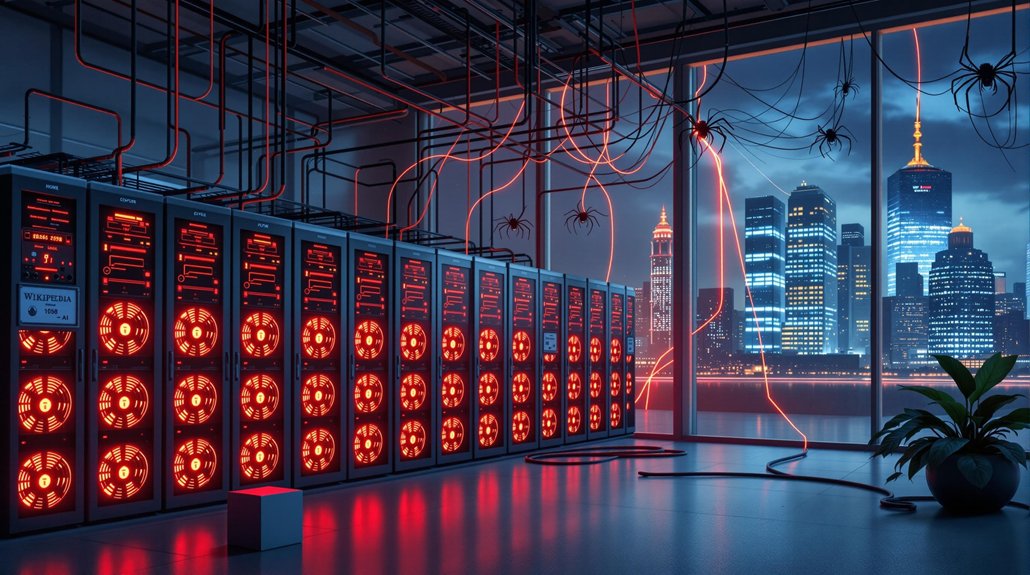
AI bots now consume a staggering 65% of resource-intensive traffic, targeting multimedia content and less popular pages unlike typical human users. This has created major operational challenges for the non-profit organization that maintains Wikipedia and its sister projects. Terabytes of data are being harvested daily from Wikimedia platforms to train large language models.
Site reliability engineers must regularly block overwhelming bot traffic to keep the website running smoothly. The increased strain affects server reliability and performance, leading to potential disruptions for regular users. Many scrapers bypass normal browser behavior, making them harder to track and manage.
The financial burden on Wikimedia has grown considerably. As a non-profit that relies on donations, the organization now faces higher costs for hardware and bandwidth due to AI scraping. Unlike human visitors, these AI systems don’t contribute donations to support the platform they heavily use.
Ethical concerns are mounting as AI companies extract value from Wikipedia without attribution or compensation. The content they scrape comes from unpaid volunteers who write and edit articles, creating an imbalance where commercial AI companies profit while giving nothing back. Current copyright laws are struggling to protect content created through collaborative human effort from being exploited by AI systems.
The problem extends beyond just reading articles. Scrapers also target code review platforms and bug tracking tools, further straining Wikimedia’s resources. This activity diverts attention and funding from community-driven improvements that would benefit actual users.
Wikimedia leadership has begun advocating for more equitable relationships with AI companies that use their data. Without changes, the foundation may need to limit bot access to preserve resources for human users.
Wikipedia’s future sustainability depends on finding solutions to this growing imbalance between contribution and consumption. The foundation’s upcoming fiscal year will prioritize establishing sustainable access channels for developers while maintaining free content availability.