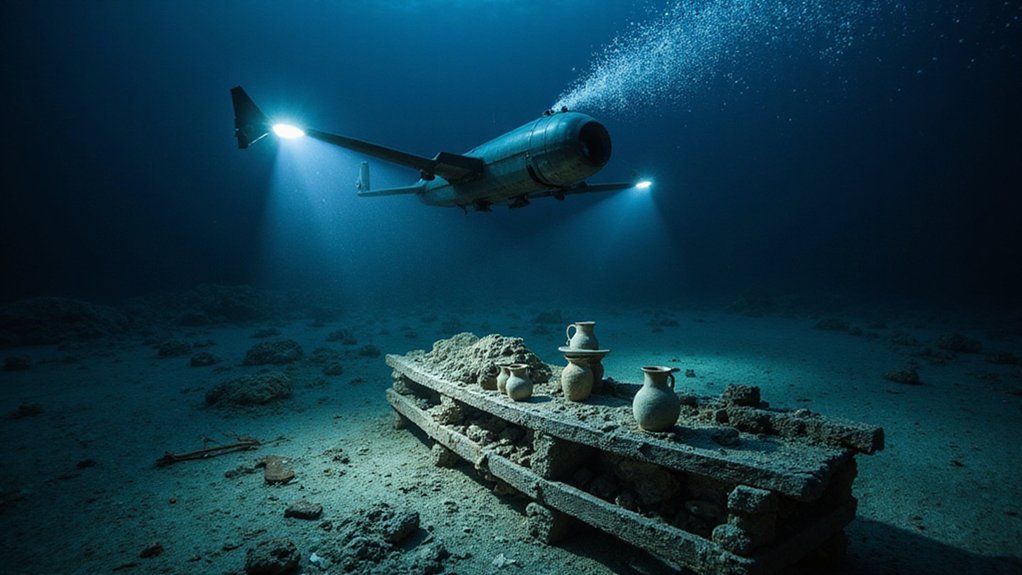

A French naval drone stumbled across a 16th-century shipwreck while mapping the seafloor off Ramatuelle last March. The discovery happened during routine deep-sea exercises in the Gulf of Saint-Tropez, when sonar equipment picked up something unusual 8,200 feet below the surface. That’s 2,567 meters for those keeping track. The deepest shipwreck ever found in French waters.
The vessel, now called Camarat 4, stretches 30 meters long and 7 meters wide. Initial images show an Italian merchant ship, probably hauling ceramics and iron bars across the Mediterranean before something went wrong. No battle damage, no obvious trauma. The ship just sank, taking its secrets down with it.
Italian merchant ship vanished without violence, carrying ceramics and iron into the Mediterranean depths.
France’s underwater archaeology department, DRASSM, jumped on this immediately. And why wouldn’t they? The previous record-holder was a wreck found at 2.3 kilometers near Toulon in 2019. This one blew that out of the water. The site’s become a genuine time capsule, frozen in the abyss where pressure and cold have kept everything eerily intact.
Over 200 ceramic pitchers and jugs sit stacked exactly where Renaissance sailors left them. Cannons, artillery pieces, an anchor. Cooking utensils scattered around like someone just stepped away from dinner prep. The robots sent down captured it all in ultra-high-definition glory. Modern garbage too – beer cans and fishing nets draped over 500-year-old artifacts. Nice touch, humanity.
The Gulf of Saint-Tropez keeps giving up its dead. Previous finds include the Lomellina and Sainte-Dorothéa, but nothing this deep, nothing this well-preserved. The French Navy’s seabed control mission accidentally uncovered what archaeologists dream about – an untouched snapshot of 16th-century maritime life. The gulf’s position along historical shipping practices between Italian ports and western Mediterranean destinations made it a natural graveyard for unfortunate vessels.
Advanced imaging tech let researchers document everything without disturbing the site. Smart move. At that depth, with those conditions, preservation is everything. The arrangement of cargo, the ship’s fittings, even the stacking patterns tell stories about Mediterranean trade routes and naval technology from half a millennium ago. Marine Sadania from DRASSM called it a genuine time capsule, confirming its exceptional archaeological value.
This exceptional discovery expands what we understand about deep-sea archaeology. It’s the deepest plunge into France’s maritime past yet achieved.
References
- https://www.lemonde.fr/en/science/article/2025/06/12/rare-16th-century-shipwreck-found-at-record-depth-in-french-waters_6742282_10.html
- https://ground.news/article/a-real-16th-century-treasure-discovered-in-a-wreck-at-a-depth-of-2-500-meters-by-the-national-navy
- https://www.aol.com/underwater-drone-stumbles-upon-frances-195400048.html
- https://www.perplexity.ai/discover/sports/military-drone-finds-16th-cent-8UdFbiCYRAKPhp1On_X1kw
- https://www.euronews.com/culture/2025/06/13/extraordinary-16th-century-shipwreck-discovered-at-record-depth-off-french-coast