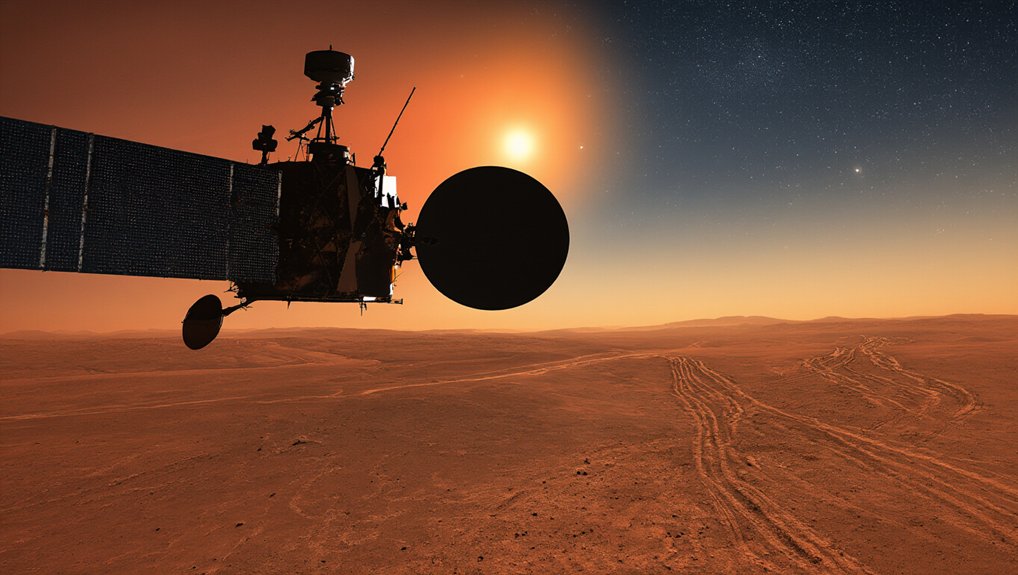
While NASA’s Mars Reconnaissance Orbiter has faithfully served as humanity’s eye in the Martian sky for nearly two decades, its remarkable mission now faces an inglorious end. After 19 years of operation—making it the third longest-lived spacecraft to orbit the Red Planet—MRO’s fate hangs in the balance. Not because it’s defunct. Because of budget cuts. Yep, we’re killing a perfectly good spacecraft.
The proposed budget would terminate science operations and relay support mid-mission. Imagine that. A working spacecraft, silenced by a spreadsheet. MRO’s HiRISE camera has been vital for mapping rover routes, despite some recent electronic hiccups causing visual artifacts. It’s like deciding to trash your car because the radio’s getting static.
These cuts couldn’t come at a worse time. MRO serves as the primary communication link between Earth and surface assets like Perseverance and Curiosity. Without it, those billion-dollar rovers would be forced to rely on older, less capable relays. It’s like downgrading from fiber internet to dial-up. In space.
Killing MRO is like ripping out fiber internet and installing dial-up for our billion-dollar Mars rovers.
The orbiter’s contributions extend beyond pretty pictures. Its data has been indispensable for site selection and safety assessments for landers and rovers. Recent maneuvers even allow for deep subsurface scans for water. MRO continues to provide critical data for Perseverance’s Northern Rim campaign as it searches for signs of ancient microbial life. As of July 2023, MRO had transmitted over 450 terabits of data back to Earth, far surpassing all other interplanetary missions combined.
Engineers have worked miracles extending MRO’s life, switching to “all-stellar” mode in 2018 when inertial measurement units deteriorated.
International collaborations will suffer too. Planned Mars sample return missions with ESA? Good luck without proper orbital support. Future surface missions designed with orbiter relay as a baseline? Back to the drawing board.
The shortsightedness is staggering. We’ve spent decades building expertise in Mars exploration, and now we’re pulling the plug on functioning hardware.
Scientists and engineers have adapted to MRO’s aging systems, implementing software updates and roll maneuvers to maintain productivity despite hardware limitations.
For a functioning spacecraft that’s proven its worth countless times over, this isn’t retirement. It’s execution.
References
- https://en.wikipedia.org/wiki/Mars_Reconnaissance_Orbiter
- https://www.nasa.gov/missions/mars-reconnaissance-orbiter/nasa-mars-orbiter-learns-new-moves-after-nearly-20-years-in-space/
- https://astrobiology.com/2025/01/proposed-route-mars-rover-perseverance-northern-rim-science-campaign.html
- https://astrobiology.com/2025/04/mars-reconnaissance-orbiter-spots-curiosity-rover-making-tracks-to-next-science-stop.html
- https://science.nasa.gov/mission/mars-reconnaissance-orbiter/stories/