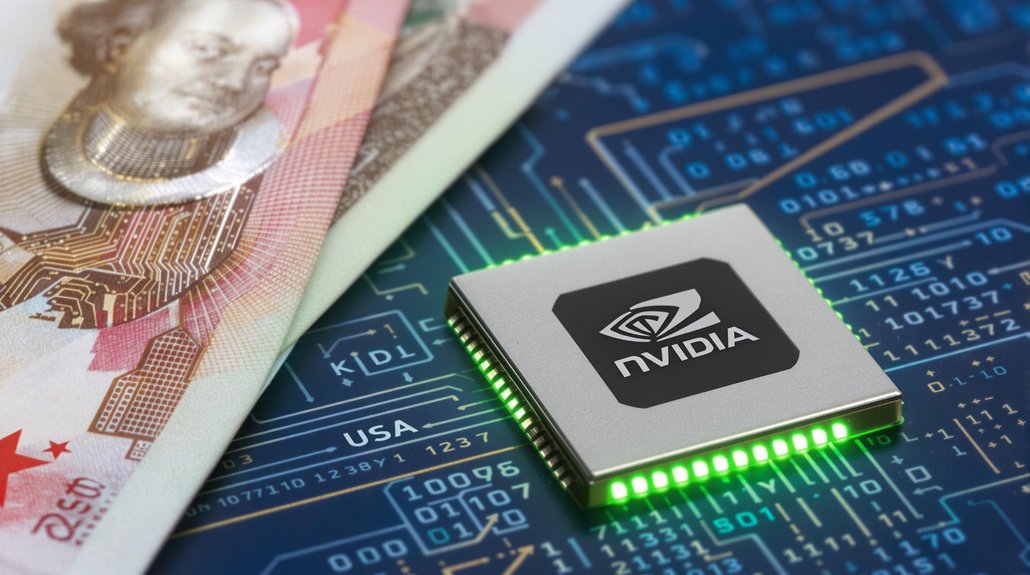

A compromise. That’s what they’re calling it. The U.S. government just flipped its China chip ban into a money-making machine, and Nvidia’s along for the ride. Instead of blocking all AI chip sales to China, Washington now takes a 15% cut of the profits. Simple as that.
The deal covers Nvidia’s H20 chips and AMD’s MI308 – the less impressive stuff, not the cutting-edge tech. Think of them as the economy class of AI chips. Good enough to run some neural networks, not good enough to worry the Pentagon. The real prize, Nvidia’s Blackwell chips, stays locked away. China won’t touch those beauties for at least five years.
Economy-class AI chips for China while the Pentagon keeps Blackwell processors locked away for five years minimum.
This whole thing started with Trump’s team demanding 20%. They settled at 15%. Public negotiation, right out in the open. Some lawmakers are calling it “policy for sale.” They’re not wrong. But here’s the thing – it could bring in billions annually. China remains Nvidia’s second-biggest market, and even these downgraded chips sell like hotcakes over there. The revenue will go toward national debt reduction and potentially benefit taxpayers directly.
The security folks are nervous. They should be. Every chip that crosses the Pacific is a calculated risk. Sure, these aren’t the chips that’ll power next-generation military AI or mass surveillance systems. But technology has a funny way of surprising people. With shipments of new H20 chips not expected until mid-2025, the current shortage creates additional market pressure. The restrictions aim to keep the really dangerous stuff – the Blackwell-class processors – far from Chinese hands. National security, they say. Technological advantage, they mean.
Chinese buyers? They’re grabbing whatever they can get. Even restricted chips beat no chips. The demand stays strong because China’s AI sector needs hardware, period. They’ll take the legal route when they can, especially if it means avoiding sketchy backdoor deals. Still, Chinese state media has started raising security concerns about Nvidia products, pushing domestic alternatives like Huawei’s chips instead.
Other sectors are watching closely. If this pilot program works, expect more “revenue-sharing” arrangements. It’s a template now. Ban something, then sell limited access for a government cut. Creative capitalism meets national security theater.
The irony’s thick. America went from “absolutely not” to “sure, for a price” in record time. Money talks, even in semiconductor politics. Whether this balance between commercial interests and security concerns holds – that’s the billion-dollar question.