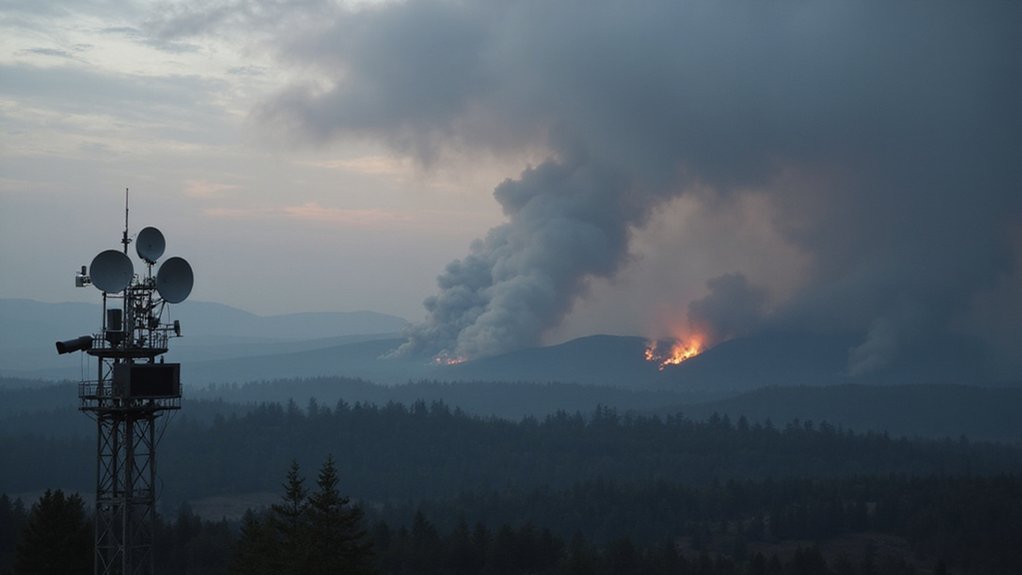

While AI wildfire detection systems have reached impressive 95% accuracy rates in controlled settings, their real-world performance falls frustratingly short when facing nature’s unpredictable challenges.
Those 95% accuracy rates and 0.1% false alarm statistics sound great in a lab. Too bad Mother Nature didn’t get the memo.
Lab statistics rarely survive their first encounter with real-world chaos. Nature plays by her own rules.
The reality? Satellite-based systems only pass over the same area every few days. Not exactly helpful when a wildfire can devour thousands of acres in hours.
And clouds? They’re AI’s kryptonite. Thick cloud cover makes even the fanciest algorithms about as useful as a chocolate teapot.
Recent CNN models trained on Amazon rainforest data did nail 23 out of 24 fire images. Impressive, sure.
But in suburban areas and wildland-urban interfaces, reflective surfaces trick these “smart” systems into crying wolf. Old systems had false alarm rates up to 30%. Ouch.
Lightning-triggered wildfires can now be predicted with over 90% accuracy, which is genuinely helpful.
The systems analyze satellite imagery in near-infrared and shortwave bands to spot vegetation changes.
But when it comes to differentiating actual smoke from fog or dust? AI still fails spectacularly.
USC’s project led by Rittenbach and Walters aims to address these challenges with deep learning algorithms that process multi-wavelength images for better accuracy.
That’s why humans remain essential. Firefighters and analysts must review AI alerts before sending expensive equipment and personnel racing across terrain.
The best systems are collaborative, combining AI speed with human judgment. Final decisions still depend on experienced personnel, not algorithms.
USC Viterbi’s system shows promise in Los Angeles, aiming for 95% detection with minimal false positives.
Insurance companies and emergency services are already incorporating these tools to reduce property loss.
The systems work best when trained on diverse, balanced datasets.
Recent research from Israeli universities integrates environmental factors such as vegetation, weather patterns, and topography to enhance prediction accuracy.
Mobile Doppler radar technology now provides unprecedented insights into fire movement patterns for more strategic containment efforts.
But let’s be real. When small fires start in remote areas with low-resolution satellite coverage, they often go undetected until they’re raging infernos.
Technology helps, but it’s not the silver bullet we hoped for.
Humans and machines together? That’s still our best shot at fighting wildfires.
References
- https://viterbischool.usc.edu/news/2025/03/detecting-wildfires-with-ai/
- https://phys.org/news/2025-04-ai-lightning-wildfires-unprecedented-accuracy.html
- https://www.risk-strategies.com/blog/how-ai-fire-technology-and-insurers-are-reinventing-wildfire-detection-in-2025
- https://modernsciences.org/ai-wildfire-detection-amazon-rainforest-accuracy-march-2025/
- https://cosmosmagazine.com/earth/ai-wildfire-detection-improves-response/