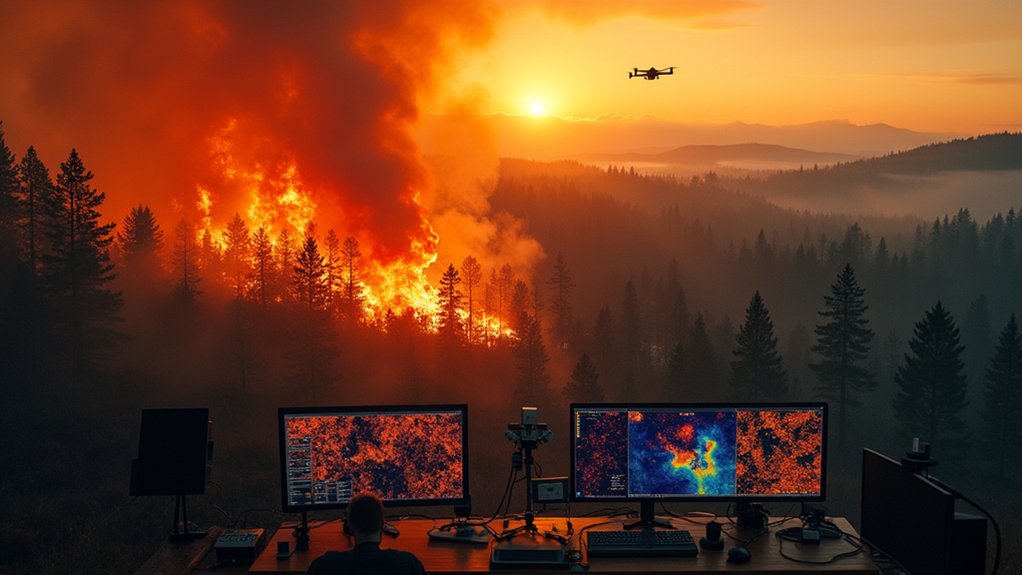

Wildfires rage across terrains with increasing ferocity each year. Tech startups are fighting back with AI solutions that transform prevention efforts. These companies use satellite imagery and weather data to detect fires earlier and predict their paths. Their systems can forecast high-risk conditions with over 90% accuracy. Firefighters now deploy resources more strategically based on AI-driven insights. The technology doesn’t just save forests—it’s saving communities threatened by climate change’s growing wildfire challenge.
As wildfires become more frequent and destructive across the globe, scientists are turning to artificial intelligence for solutions. USC Viterbi‘s Information Sciences Institute is leading this charge with an AI-powered surveillance system set to launch in 2025. This innovative technology analyzes satellite imagery in real-time, spotting fires while they’re still small and manageable.
The USC system promises remarkable accuracy, aiming for a 95% fire detection rate while reducing false alarms to just 0.1%. This represents a massive improvement over current systems that can trigger false alarms up to 30% of the time in wildland-urban interface areas.
A breakthrough AI model for predicting lightning-induced wildfires is also transforming how we manage these disasters. With over 90% accuracy in predicting where and when lightning strikes will cause fires, this technology marks a first in wildfire management. Scientists continue to refine these models with up-to-date climate data.
Real-time forecasting systems now update constantly using weather data to protect lives and property. These systems predict fire likelihood in the coming days and continuously improve as new meteorological information becomes available. The cost-effective approach uses existing data and infrastructure, making it accessible for regions with limited resources.
AI-driven forecasting offers affordable wildfire protection through continuous updates and accessible implementation.
The impact is significant. One AI model achieved a 47% improvement in predicting critical pre-fire conditions compared to existing methods. This enhanced accuracy enables faster evacuations and more effective resource allocation for firefighting efforts. This innovation comes at a crucial time when climate refugees are increasing due to uninhabitable conditions created by extreme wildfires and environmental degradation.
These advances help overcome limitations in current satellite monitoring, which often provides infrequent or low-resolution coverage. Traditional systems struggle with small fires and can be confused by reflective surfaces like rooftops and solar panels. The project led by Rittenbach and Walters aims to address these specific challenges with their deep learning algorithms.
Government investment in AI-based wildfire management continues to grow, establishing these technological advances as a key trend to monitor in 2025 and beyond. As machine learning algorithms improve, these systems will play an increasingly essential role in protecting communities from devastating wildfires.
Integration of Mobile Doppler radar technology with AI systems is providing unprecedented insights into fire behavior and movement patterns, allowing for more strategic containment efforts.
References
- https://viterbischool.usc.edu/news/2025/03/detecting-wildfires-with-ai/
- https://www.columbiasouthern.edu/blog/blog-articles/2025/april/wildfire-trends/
- https://phys.org/news/2025-04-ai-lightning-wildfires-unprecedented-accuracy.html
- https://www.smithsonianmag.com/science-nature/how-ai-can-help-humans-battle-wildfires-from-advanced-camera-systems-to-forecasting-models-180985934/
- https://phys.org/news/2025-01-wildfires-ai-powered-tool-combat.html