President Trump reversed planned restrictions on Nvidia’s H20 chip exports to China following a meeting with CEO Jensen Huang at a million-dollar-per-plate fundraiser at Mar-a-Lago. The chip, designed for Chinese AI companies while complying with U.S. regulations, was set to face new export limits in April 2025. Nvidia has pledged to increase investment in U.S. AI data centers in return. This decision highlights the balance between national security and economic interests.
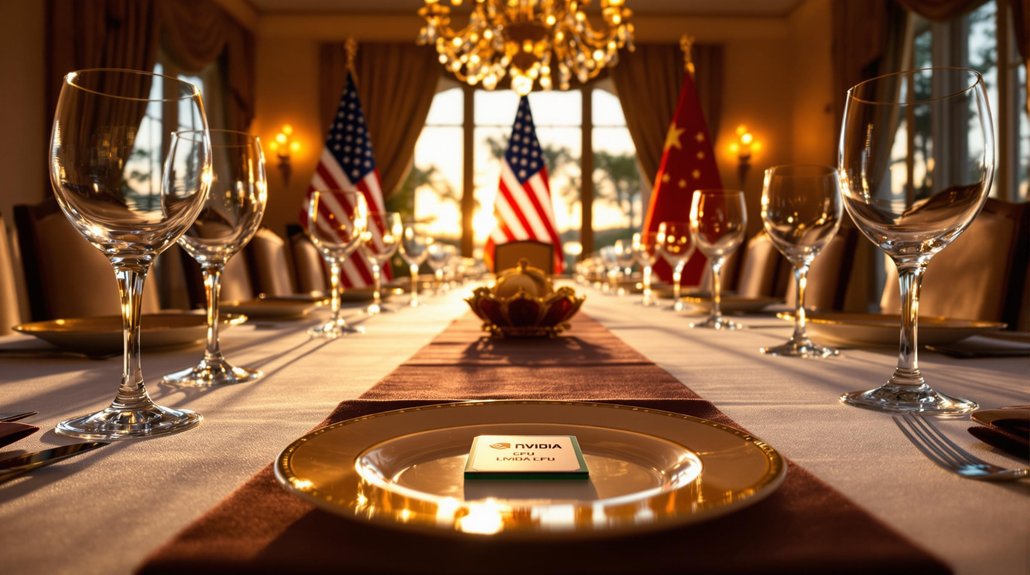
President Trump has reversed course on planned restrictions for Nvidia’s H20 chip exports to China, following a high-profile meeting with the company’s CEO Jensen Huang. The decision came after a fundraising dinner at Trump’s Mar-a-Lago estate where attendees reportedly paid $1 million per person to participate.
In a dramatic policy pivot, Trump scrapped H20 chip restrictions after meeting Nvidia’s CEO at a million-dollar-per-plate fundraiser.
The H20 chip, specifically designed by Nvidia to comply with U.S. export regulations, has been a critical component for Chinese companies developing artificial intelligence technologies. The chip was set to face new export restrictions in early April 2025 as part of the U.S. government’s efforts to limit China’s access to advanced technology. These restrictions were fully prepared and ready for implementation when the White House suddenly reversed its decision.
Nvidia has pledged to increase its investment in AI data centers across the United States, though specific details about the size and scope of these investments haven’t been disclosed. This promise appears to have influenced the administration’s decision to remove the H20 chip from the export control list.
The U.S. initially banned Nvidia’s most advanced AI processors from being sold to China in 2022, citing concerns about Beijing’s technological advancement. The H20 was Nvidia’s response – a modified chip that met U.S. regulatory requirements while still providing Chinese firms with powerful AI capabilities. With over 4,500 AI companies operating in China, the demand for advanced chips remains substantial despite export controls.
Despite China’s push toward semiconductor independence and encouragement for domestic companies to use locally-made AI chips, Chinese firms remain heavily dependent on Nvidia’s technology. Companies like Huawei and Cambricon Technologies have worked to develop alternatives, but haven’t matched Nvidia’s performance. Beijing has issued window guidance to regulators encouraging the use of domestic vendors over foreign options like Nvidia.
U.S. regulators have also faced challenges enforcing existing restrictions, with reports of Nvidia chips reaching China through indirect channels and smuggling operations. These compliance issues have highlighted the difficulties in controlling the flow of sensitive technologies.
The policy reversal represents a delicate balancing act between national security concerns and economic interests. American lawmakers have pressed for stricter controls on advanced AI technology exports, while tech industry leaders have warned about potential economic impacts of excessive restrictions on global trade.