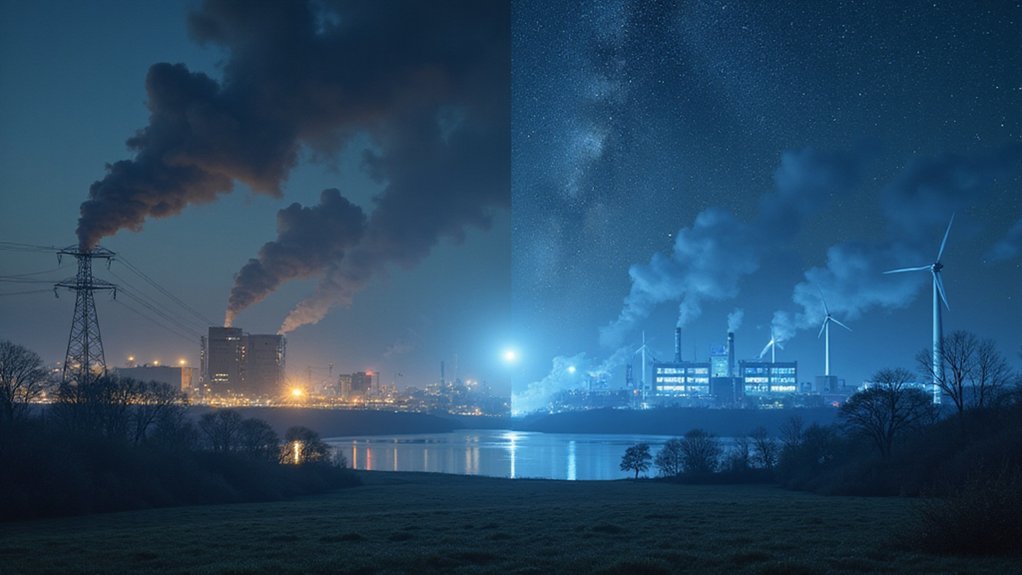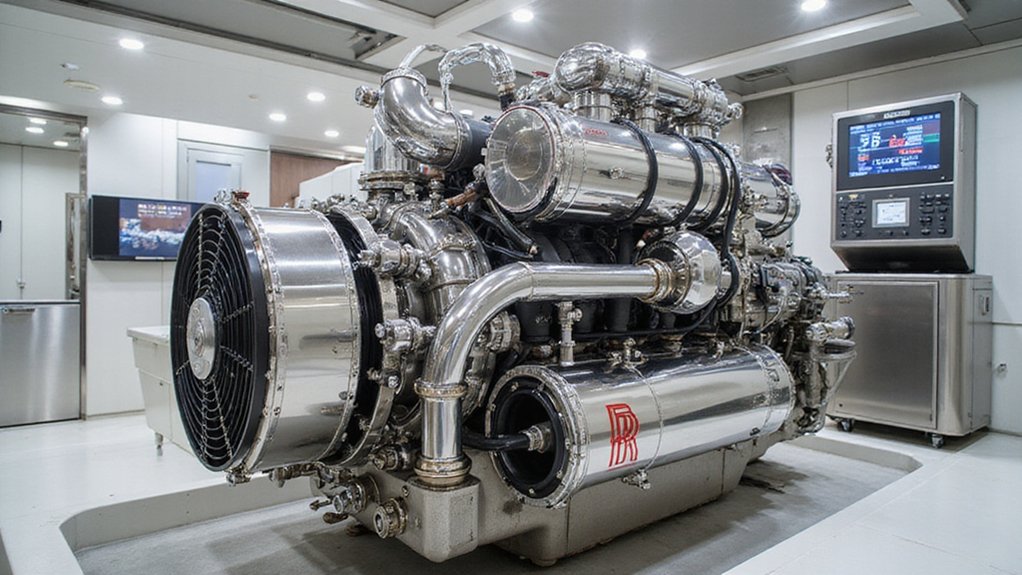

Superyacht owners have exactly three things they care about: going fast, looking good, and pretending to care about the environment. Rolls-Royce gets it. Their latest 12-cylinder mtu Series 2000 M96Z engine pumps out 2,222 metric horsepower of pure marine muscle. That’s enough power to make a floating mansion feel like a speedboat.
2,222 horsepower of pure marine muscle disguised as environmental consciousness.
The numbers are ridiculous. This V12 monster can spin up to 2,450 rpm in some variants, burning through 316 liters of diesel every hour at full throttle. That’s 83.5 gallons, for those keeping track. The fuel bill alone could fund a small country’s education budget. But hey, at least it meets DIN EN 590 standards. The engine also runs on HVO renewable diesel, so yacht owners can feel green while burning through their fortune.
Here’s where it gets interesting. Rolls-Royce slapped on some fancy tech like Smartline, blueline, and BlueVision systems. These aren’t just buzzwords. They actually monitor engine performance in real-time, squeezing out every drop of efficiency from this beast. The company calls it “eco-luxe” propulsion. Sure, burning 83 gallons an hour is totally eco-friendly.
The engine complies with every maritime classification society you’ve never heard of: ABS, BV, CCS, DNV, GL, KR, JG, LR, NK, and RINA. It’s like collecting Boy Scout badges, but for billionaires.
NOx and particulate emissions? Reduced. Noise and vibration? Minimized with resilient mounting systems. The dolphins will appreciate the quieter approach as the yacht blazes past at 30 knots.
Integration is seamless, apparently. Multiple gearbox configurations, hydraulic pump drives, auxiliary PTOs. It’s a Swiss Army knife of marine propulsion. Need a hybrid system? They’ve got you covered. Want to connect it directly to propulsion shafts? No problem.
The Bergen engines in Rolls-Royce’s superyacht lineup range from 1,800 to 8,000 kW, because sometimes 2,222 horsepower just isn’t enough. These engines represent the cutting edge of diesel marine technology, where environmental regulations meet the unstoppable force of wealthy people wanting to go really, really fast on water.
References
- https://www.rolls-royce.com/media/press-releases/2020/15-09-2020-rr-mtu-series-2000-yacht-engine-with-more-than-2000-mhp.aspx
- https://www.mtu-solutions.com/content/dam/mtu/products/defense/marine-and-offshore-service-and-supply/main-propulsion/mtu-series-2000/3231701_Marine_spec_12V16V2000M92_1DS.pdf/_jcr_content/renditions/original./3231701_Marine_spec_12V16V2000M92_1DS.pdf
- https://www.rolls-royce.com/media/press-releases/2025/27-05-2025-new-mtu-2000-engine-from-rolls-royce-with-more-power-for-fast-vessels-and-yachts.aspx
- https://www.superyachtfan.com/yacht-industry/yacht-engines/
- https://en.wikipedia.org/wiki/Rolls-Royce_Crecy