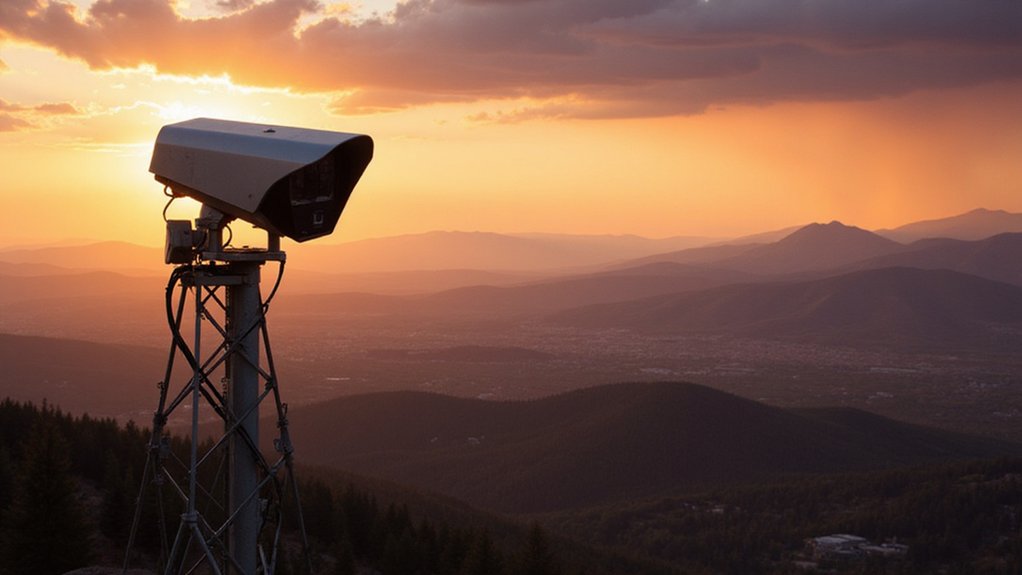

When Santa Fe officials started worrying about wildfires creeping closer to their city, they didn’t just cross their fingers and hope for the best. They got smart. Real smart. The Greater Santa Fe Fireshed Coalition, along with at least two other local organizations, decided to stick a high-tech camera on Tesuque Peak and let artificial intelligence do the watching.
This isn’t your average security camera. We’re talking pan-tilt-zoom capabilities that would make a Hollywood cinematographer jealous. The thing can spot smoke plumes 25 miles away during the day. At night? It switches to infrared and extends its reach to 50 miles. Because apparently, fires don’t sleep.
The whole setup runs on ALERTWest technology, part of a camera network that’s spreading across the West like, well, wildfire. The live feed shoots straight to a monitoring center in California, where AI algorithms scan every frame for signs of trouble. Smoke? Flame? The AI catches it. Then actual humans double-check before anyone hits the panic button. No false alarms from someone’s backyard barbecue.
AI algorithms scan for smoke while humans verify – no backyard barbecue false alarms here.
Here’s the kicker: anyone can watch. The feed is public. Want to see if that weird cloud is smoke or just weather? Log on. It’s transparency at its finest, borrowed from successful networks like ALERTCalifornia.
Emergency responders love it. Early detection means faster deployment, better evacuation planning, and maybe – just maybe – saving some lives and property. The system represents a significant improvement over traditional monitoring methods which often suffer from high false alarm rates of up to 30%. The economic and environmental assets around Santa Fe aren’t cheap to replace. For Jonathan Frenzen, whose family cabin was touched by the 2011 Wallow Fire, this technology represents more than just progress – it’s personal.
This tech trend isn’t unique to Santa Fe. Insurance companies are throwing money at these systems because paying for cameras beats paying out massive wildfire claims. Climate change is making fire seasons longer and nastier. Communities are adapting with drones, sensors, and yes, AI cameras that never blink. Some systems perform 360-degree sweeps every two minutes, creating a comprehensive surveillance network that leaves no blind spots.
The data collected could eventually feed predictive models for fire prevention. More cameras might follow. The technology keeps evolving. But for now, Santa Fe has its sentinel on the peak, watching and waiting, ready to sound the alarm when smoke appears on the horizon.
References
- https://www.govtech.com/artificial-intelligence/ai-backed-camera-outside-santa-fe-n-m-to-spot-wildfires
- https://statescoop.com/ai-cameras-sensors-drones-la-wildfires-2025/
- https://www.smithsonianmag.com/science-nature/how-ai-can-help-humans-battle-wildfires-from-advanced-camera-systems-to-forecasting-models-180985934/
- https://alertcalifornia.org
- https://www.risk-strategies.com/blog/how-ai-fire-technology-and-insurers-are-reinventing-wildfire-detection-in-2025