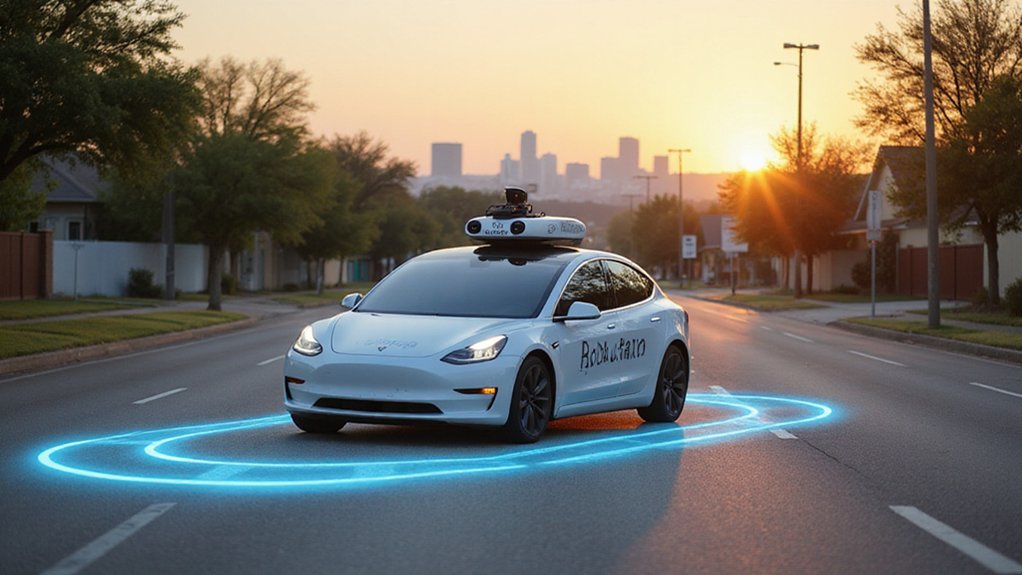
While Tesla promised a robotaxi transformation, what Austin got was 10 cars crawling through carefully selected neighborhoods with human babysitters in every vehicle. The much-hyped autonomous future looks more like a carefully choreographed dance around the city’s easiest streets.
Tesla’s robotaxi fleet operates from 6 AM to midnight, but only if you’re lucky enough to get an invite. The company picked Austin’s simplest roads for this experiment, avoiding complex intersections entirely. Because nothing says “revolutionary technology” like dodging the hard parts. This approach highlights the regulatory gaps that exist across different states regarding autonomous vehicle testing.
Each car comes with a Tesla employee riding shotgun, plus someone watching remotely who can grab control if things get dicey. The vehicles use Tesla’s camera-only Full Self-Driving system. No lidar, no radar, just cameras and faith in neural networks. Current data shows the system requires a critical disengagement every 444 miles, raising serious questions about accident risks.
They’ve trained the system specifically on Austin data, which apparently means teaching it to drive really, really slowly – likely under 20 mph. Speed demon territory, this is not. The service runs through a dedicated app that participants must download to hail rides within the geofenced area.
Texas lawmakers aren’t thrilled. They’ve formally asked Tesla to pump the brakes on this rollout.
References
- https://electrek.co/2025/06/16/tesla-robotaxi-launch-dangerous-game-smoke-mirrors/
- https://www.teslarati.com/tesla-has-started-rolling-out-robotaxi-invites/
- https://www.thestreet.com/technology/teslas-robotaxi-rollout-runs-into-trouble-texas
- https://philkoopman.substack.com/p/tesla-robotaxi-deployment-in-austin
- https://teslanorth.com/2025/06/19/tesla-robotaxi-service-launch-with-only-10-cars/